

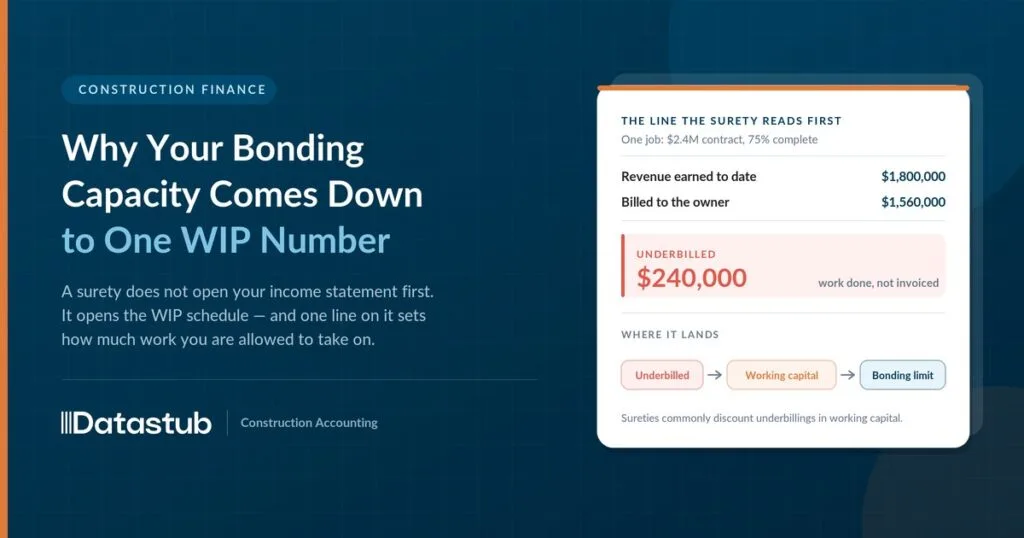
When a surety underwriter evaluates your bonding capacity, working capital is one of the numbers that matters most. But a balance sheet doesn’t tell the whole story. Your WIP report tells the surety whether that reported working capital is supported by profitable work, realistic cost estimates, and healthy billing practices, or whether some of it is borrowed from jobs that haven’t earned it yet.
You might see $220,000 of working capital on your balance sheet and assume you have the financial strength to take on a $1.8 million project. A surety looking at the same company, analyzing the same WIP schedule, can arrive at a very different number. That gap is exactly where contractors get surprised, usually right before a bid, when there’s no time left to fix it.
Here’s how the two connect, and what to check before your next bonding renewal.
What a WIP Report Is Actually Measuring
Strip away the spreadsheet and a WIP report answers one question, job by job: have you earned more revenue than you’ve billed, or billed more than you’ve earned?
For each active project, the underlying math is job costing rolled up and compared against billing:
- Percent complete = costs incurred to date ÷ total estimated cost
- Earned revenue = percent complete × total contract value
- Billing position = billings to date − earned revenue
A positive billing position means the job is overbilled: you’ve billed more than the revenue you’ve actually earned. A negative one means it’s underbilled: you’ve done work that isn’t invoiced yet. Roll every active job’s billing position into one schedule, and that’s your WIP report. It’s only as reliable as the job costing underneath it; if costs are tracked loosely at the job level, the WIP report inherits that looseness.
A simple example. A $600,000 contract has $240,000 in costs incurred against a $400,000 total estimated cost. That’s 60% complete, so earned revenue is $360,000. If you’ve billed $410,000, your billing position is $50,000 overbilled.
That alone doesn’t mean anything is wrong. A front-loaded billing schedule can explain it. The concern starts when significant overbilling or underbilling shows up repeatedly across multiple projects, or when estimated profits stop holding up as jobs progress. That’s where the WIP report becomes something your surety reads closely.
The Working Capital Number Sureties Actually Multiply
Sureties weigh a range of factors (net worth, profitability, backlog, experience, financial statement quality), but working capital is the base figure most of the math runs from. In its simplest form:
Working capital = current assets − current liabilities
A surety doesn’t necessarily accept that balance-sheet figure at face value. Underwriting typically involves adjusting it, stripping out aged receivables, related-party balances, and anything else that isn’t genuinely available liquidity, to arrive at what’s often called analyzed working capital. That adjusted number, not the one on your internal statements, is what capacity actually gets built from.
Industry sources describe the multipliers as a starting point, not a fixed formula:
| Capacity measure | Illustrative range | What it means |
|---|---|---|
| Single-job capacity | Roughly 8–12× working capital | Size of the largest individual bonded project you can take on |
| Aggregate capacity | Roughly 15–20× working capital | Total value of bonded work you can carry at once |
| Net worth to backlog | Roughly 10–20% of open bonded work | A financial cushion benchmark behind your active backlog |
These are underwriting norms, not statutory rules. Every surety weighs its own book differently, and your actual numbers should be confirmed with your bonding agent. But the shape holds broadly: $150,000 of working capital a surety accepts at face value, run through a 10× single-job multiple, suggests roughly $1.5 million of single-project capacity. Move the working capital number, and the capacity moves with it, which raises the real question: how much of your reported working capital will the surety actually recognize as available?
That’s where your WIP report starts to matter more than your balance sheet does.
How Overbilling Quietly Shrinks the Number
A balance sheet can show strong working capital while the WIP report tells a more complicated story. Cash sitting on your books from overbilled jobs looks like working capital on paper. To an underwriter, it isn’t quite that: it’s cash collected against work the job hasn’t earned yet, and it raises a specific set of questions: is the billing position sustainable, are the cost-to-complete estimates accurate, is the company financing one job with cash from another, and does the balance sheet overstate the real cushion behind new bonded work?
A surety does not necessarily calculate analyzed working capital by simply subtracting total overbilling from reported working capital dollar-for-dollar. The exact treatment depends on the underwriter’s full review of your financial position. But directionally, the more of your liquidity that’s tied up in cash advanced against unfinished work, the less of it a surety is willing to count as a genuine cushion.
Underbilling raises a different question. It isn’t automatically bad. Timing differences, retainage, and pending change orders can all explain it. But persistent underbilling, especially late in a project, tells an underwriter that either your billing process isn’t keeping pace with the work or your cost-to-complete estimates aren’t holding up. Either way, the pattern matters more than a single instance: one overbilled or underbilled job prompts a question, but a pattern across projects or reporting periods is what actually moves the capacity number.
That pattern has a name: profit fade, when a job’s expected profit declines as it progresses. A project estimated at $200,000 in profit that closes at $100,000 hasn’t just underperformed; it’s told the surety that the original estimate didn’t reflect what was actually happening in the field. One instance gets noticed. A recurring pattern across projects becomes a real underwriting concern.
A Worked Example: From WIP to Bonding Capacity
The figures below are illustrative, built to show the mechanics rather than drawn from a specific contractor’s file.
A mid-sized general contractor with three active projects reports $220,000 in working capital on its internal balance sheet. Here’s how that number moves once the WIP report enters the picture.
Step 1: The unadjusted capacity
At face value, using a 10× single-job multiplier and an 18× aggregate multiplier:
- Single-job capacity: $220,000 × 10 = $2.2 million
- Aggregate capacity: $220,000 × 18 = $3.96 million
That looks like enough room for the $1.8 million subcontract the company is about to bid.
Step 2: What the WIP report shows
| Job | % Complete | Earned Revenue | Billed to Date | Billing Position |
|---|---|---|---|---|
| A | 75% | $375,000 | $450,000 | $75,000 overbilled |
| B | 40% | $320,000 | $395,000 | $75,000 overbilled |
| C | 90% | $540,000 | $600,000 | $60,000 overbilled |
Total overbilling across active jobs: $210,000, nearly the entire reported working capital figure.
Step 3: The adjusted capacity
A surety won’t necessarily net that $210,000 straight against the $220,000. The exact treatment depends on the underwriter’s full review, not a fixed formula. But suppose, for illustration, that after reviewing the full financial picture the underwriter determines only $50,000 of working capital is genuinely available for capacity purposes. Run that adjusted figure through the same multipliers:
- Single-job capacity: $50,000 × 10 = $500,000
- Aggregate capacity: $50,000 × 18 = $900,000
Nothing about the company’s actual balance sheet changed in that conversation. What changed is how much financial strength the surety was willing to recognize once the WIP report was factored in, and the $1.8 million bid the company was counting on is no longer bondable on this file.
Five WIP Mistakes That Wreck the Number
Optimistic cost-to-complete estimates. The single most damaging habit. Underestimate the cost remaining on a job and you overstate both percent complete and earned revenue, setting up profit fade the moment real costs catch up.
Updating WIP once a year instead of monthly. An annual schedule tells you what happened at year-end. It doesn’t give you time to fix a problem while it’s still fixable. A margin issue caught in March is a conversation with your bonding agent; the same issue discovered during a year-end renewal is a capacity cut.
Treating overbilled cash as unrestricted cash. It improves short-term liquidity, but it isn’t free money: it belongs to a job that hasn’t earned it yet. If your cash position depends heavily on billing ahead of the work, that’s worth understanding in your cash flow planning before it shows up as a surprise in a bonding review.
Posting labor and material costs late. Costs recorded late understate costs-to-date, which distorts percent complete, earned revenue, and billing position all at once. The WIP report is only as accurate as the cost data underneath it.
Misclassifying retainage. Retainage, typically 5–10% of each invoice, is a real receivable, but it isn’t cash in hand. Reporting it the same way as collectible receivables overstates the liquidity a surety will actually recognize.
What to Do Before Your Next Bond Renewal
You don’t need to wait for your surety to find a problem first.
- Know your analyzed working capital before the surety calculates it for you. Ask your CPA, or a virtual CFO already tracking this for you, which adjustments an underwriter is likely to apply, so you’re working from the real number, not the balance-sheet number.
- Move to monthly WIP updates, built into the same month-end close process you already run rather than a separate year-end exercise.
- Validate percent-complete against actual job-site progress, not just the cost ledger. A large material purchase can push accounting costs ahead of physical progress.
- Ask about reviewed or audited financials if you’re still submitting internally prepared or compiled statements. Underwriters weight a second set of eyes on the numbers more heavily.
- Bring your bonding agent the WIP report before they ask for it. A contractor who already knows where their overbilling sits reads as disciplined. One who gets surprised by their own numbers reads as a risk.
Frequently Asked Questions
How quickly can a surety cut your bonding capacity once they spot a problem?
It can happen at the next review, often the annual renewal, but sooner if a surety requests updated financials after seeing a red flag mid-year. A single overbilled job rarely triggers an immediate cut; a repeated pattern of profit fade or growing overbilling across renewal cycles is what typically does.
Is there a set working capital requirement for bonding?
No universal figure exists. Sureties weigh working capital alongside net worth, profitability, backlog, and financial statement quality. Industry multiples offer a starting point, but your actual capacity depends on your specific file and surety relationship.
Does underbilling hurt bonding as much as overbilling?
Not usually to the same degree, but persistent or unexplained underbilling, especially late in a project, raises its own questions about billing discipline and cost estimate accuracy. Sureties read both patterns as signals; neither is automatically disqualifying on its own.
How often should contractors update their WIP report?
Monthly, for any contractor carrying active bonded work. It’s the only cadence that gives you time to catch a margin or billing problem before it shows up in a bonding conversation instead of a routine monthly review.
The Habits That Keep the Number Healthy
Contractors who never get a bonding-capacity surprise share a few habits: they update WIP monthly without being asked, they treat cost-to-complete estimates as something to defend with field evidence rather than optimism, and they know their analyzed working capital number before any conversation with a surety starts.
None of that requires new software or a finance department. It requires reading the WIP report every month with the same eyes a surety would use, and catching the drift while it’s still a line item, not a lost bid.
If your WIP report hasn’t been updated since your last set of financial statements, that’s the place to start. We build monthly contractor bookkeeping and WIP reporting processes so this number is accurate before a renewal, not reconstructed under pressure right before one. Reach out to Datastub for a free WIP and bonding-readiness review, and we’ll tell you straight where your numbers stand.
This article is for general informational purposes and does not replace advice from your CPA, bonding agent, or surety underwriter. Surety underwriting criteria vary by carrier and contractor, and the illustrative ratios and examples above should not be treated as guaranteed bonding limits. For further reading, the National Association of Surety Bond Producers maintains contractor-facing resources on the bonding process.