


If you’re a small business owner or startup founder, you’ve probably heard the phrase “tax credit” thrown around at networking events or in conversations with your accountant. But here’s the thing: most small business owners don’t know that there is a specific tax credit designed just for them that could put hundreds of thousands of dollars back into their business.
We’re talking about the Qualified Small Business (QSB) Payroll Tax Credit—and it’s one of the best-kept secrets in small business finance.
In this guide, I’ll break down exactly what this credit is, who qualifies, how much you could save, and how to claim it. This straightforward information helps you to understand if your business is leaving money on the table.
Common Misconceptions About the QSB Credit

Before we go further, let’s clear up some myths that prevent small business owners from claiming this credit:
Myth #1: We’re not a tech company, so we don’t qualify
Reality: While tech and SaaS companies are common claimants, any industry that invests in R&D can qualify. This includes manufacturing, e-commerce, biotech, software, fintech, and even some service-based businesses. If you’re improving a product or process through experimentation, you likely qualify.
Myth #2: We’re too small to qualify
Reality: The QSB credit is specifically designed for small businesses. In fact, startups and early-stage companies often have the most to gain from this credit because they’re typically investing heavily in R&D relative to their revenue.
Myth #3: We only qualify if we’re pre-revenue
Reality: You can claim this credit whether you’re pre-revenue, early-stage, or profitable. The key is that you conducted qualified R&D activities during the year.
Myth #4: Claiming this credit will trigger an audit
Reality: While any tax credit should be properly documented, legitimate claims that are well-supported by documentation rarely trigger audits. In fact, the IRS actively encourages small businesses to claim this credit.
What the R&D Payroll Tax Offset Actually Is
The federal R&D tax credit (officially called the “Credit for Increasing Research Activities,” or IRC Section 41) has existed since 1981. It rewards companies for spending money on research and development inside the United States.
For decades, there was one big problem for startups: the credit only reduced income tax. If your company had no income tax bill (because you were losing money), the credit just sat there, useless, waiting for a profitable year.
The 2015 PATH Act changed this. Since 2016, startups can use their R&D credit to lower their payroll taxes instead of just waiting until they are profitable.
The cap was $250,000 a year. The cap doubled by the Inflation Reduction Act 2022. Starting 2023 tax year, you can apply up to $500,000 of R&D credit per year against payroll taxes. After you exhaust your employer Social Security tax bill, any leftover credit can also offset your employer Medicare tax.
In simple terms: you do R&D work, you calculate a credit, you tell the IRS you want to use it against payroll tax, and your quarterly payroll tax bill goes down. The savings hit your bank account as money that you do not have to pay to the government as employer portion of payroll tax.
Meet BuildFlow — Our Running Example
To understand this better, Let’s take an example of Buildflow.
BuildFlow, Inc. is a 3-year-old SaaS startup in Northern Virginia. They build project management software for construction contractors. Here is what their 2025 looks like:
- Founded in 2022, first paying customers in 2023
- 12 employees: 8 engineers, 4 in sales and operations
- 2025 gross receipts: $800,000
- Engineering payroll: $600,000
- Other Staff payroll: $200,000
- Cloud hosting and development tools: $120,000
- Outside contractors (a freelance ML engineer): $80,000
- Net income: a loss of about $250,000
John, founder of BuildFlow assumes that he cannot take advantage of the R&D credit because the company is not profit making. I will show you why this costly misconception — and exactly how much cash he leaves on the table by not filing.
Step 1: Does Your Company Qualify? (The QSB Test)
To use the payroll tax offset, your business must be a Qualified Small Business. There are two rules, and you have to pass both.
Rule 1: Less than $5 million in gross receipts for the current tax year.
Gross receipts means revenue — all of it, before any deductions. If your top-line revenue for the tax year is $5 million or more, you do not qualify for the offset. You can still claim the regular R&D credit; you just cannot apply it to payroll taxes.
Rule 2: No gross receipts in any year before the past five years.
This is the tricky one. To claim the offset for the 2025 tax year, your company cannot have had any revenue in 2019 or earlier. The IRS is specifically targeting young companies. Even one dollar of revenue more than five years ago disqualifies you.
A few things to know:
- “No gross receipts” includes interest income from a bank account. If your founder put money in a startup checking account in 2018 and earned $12 of interest, that counts as gross receipts for 2018 — and you are disqualified.
- If you have related companies (parents, subsidiaries, sister companies under common ownership), their gross receipts get aggregated with yours. A holding company with old revenue can ruin your eligibility.
- You can use the offset for a maximum of five tax years total. The lifetime cap is $2.5 million ($500,000 × 5).
BuildFlow’s status: Founded in 2022, first revenue in 2023, 2025 gross receipts of $800,000. They pass both tests. They qualify as a QSB.
Step 2: What Counts as R&D? (The Four-Part Test)
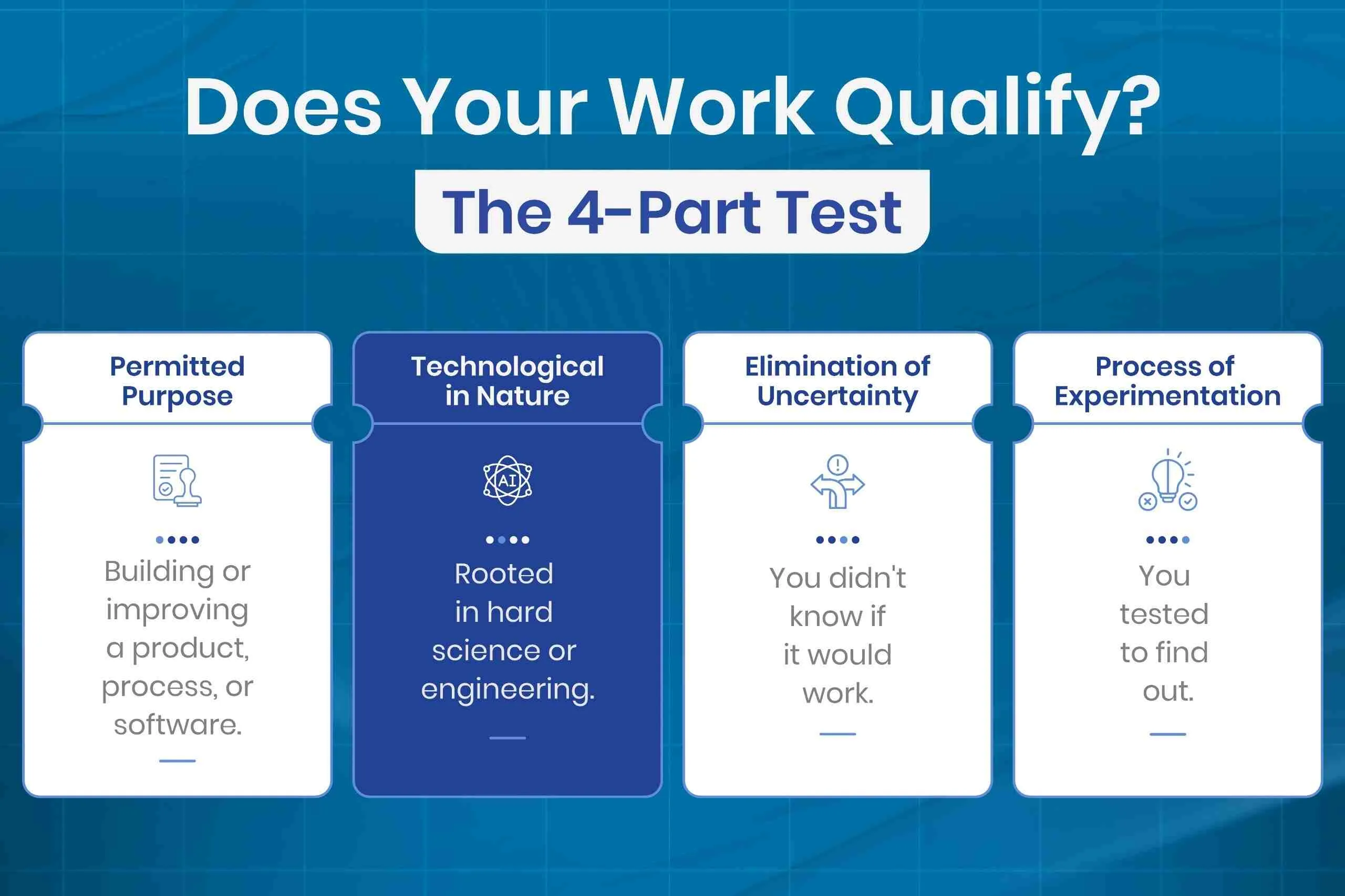
The IRS requires more than just your claim that a project involves research. To qualify, an activity must pass all four parts of what tax professionals call the “four-part test”.
- Permitted purpose. The work has to be aimed at creating or improving a product, process, software, technique, formula, or invention. It has to make something new or make something existing better, faster, cheaper, more reliable, more efficient.
- Technological in nature. The work has to rely on hard sciences — engineering, computer science, physics, chemistry, biology. Building a new algorithm, designing a new mechanical part, or developing new software architecture.
What does not qualify — Marketing experiments, customer research, and UX polish. - Elimination of uncertainty. At the start of the project, you did not know if it would work or how to make it work. There was genuine technical uncertainty about capability, methodology, or design.
- Process of experimentation. You evaluated alternatives — through modeling, simulation, prototyping, systematic trial and error — to resolve that uncertainty.
What usually qualifies:
- Building or improving software features (especially anything involving new algorithms, integrations, performance work, or technical architecture)
- Designing and testing new hardware or mechanical products
- Developing new manufacturing processes
- Creating new chemical formulations, recipes, or materials
- Building machine learning models or data pipelines
- Cybersecurity research
What does not qualify:
- Routine bug fixes and maintenance
- Cosmetic changes and visual redesigns with no technical complexity
- Market research, surveys, customer interviews
- Research conducted outside the United States
- Work funded by someone else (grants, customer-funded development where the customer keeps the IP)
- Adapting an existing product for a specific customer
BuildFlow’s qualifying work: Their engineers spent most of 2025 building a new automated scheduling engine designed to reorganize construction workflows following project delays. It uses machine learning to predict ripple effects across a job site. This involved real technical uncertainty (would the model be accurate enough?) and a process of experimentation (they tested multiple algorithms and architectures). It clearly qualifies. The 20% of engineering time spent on routine bug fixes and customer support does not qualify.
Step 3: What Expenses Count?
Once you have identified qualifying R&D activities, you can count specific types of expenses tied to those activities. These are called Qualified Research Expenses, or QREs.
There are four main buckets:
- Wages. W-2 wages paid to employees for time spent on qualifying R&D work. This includes the engineers doing the work, the supervisors directly managing them, and people directly supporting them (like a QA engineer testing the new feature). You allocate by time — if an engineer spent 75% of the year on R&D, 75% of their wages count.
- Supplies. Tangible materials used and consumed in R&D. For software companies, this category is usually small. For hardware or manufacturing companies, it can be huge (prototype materials, lab supplies, test parts).
- Contract research. Payments to outside contractors and consultants who perform R&D work for you. The catch: you can only count 65% of these payments, and the contractor’s work has to be performed in the United States.
- Cloud computing and rental. Payments for cloud servers, dev environments, and computing resources used for qualified research. This is huge for software startups. AWS, Google Cloud, Azure, and similar costs tied to development and testing environments all count.
BuildFlow’s QREs:
| Expense Category | Total Spent | % Related to R&D | QRE Amount |
| Engineering wages | $600,000 | 80% | $480,000 |
| Cloud hosting (dev/test environments) | $120,000 | 70% | $84,000 |
| Outside ML contractor | $80,000 | 65% allowed × 100% R&D | $52,000 |
| Total QREs | $616,000 |
Note we used 80% for engineering wages because the engineers spent roughly 20% of their time on bug fixes, support, and meetings unrelated to qualifying work. And we used 70% of cloud hosting because part of it ran production systems for paying customers, not development work.
This kind of allocation is where careful documentation pays off. If the IRS asks, you need to show how you arrived at these percentages — time tracking, project records, calendar entries, technical specs.
Step 4: Calculating the Credit
There are two methods for calculating the R&D credit: the Regular Credit and the Alternative Simplified Credit (ASC). Almost every startup uses the ASC because it is simpler and does not require historical data from 1984.
The ASC works like this:
- If your company has at least three prior years of QREs: The Credit is 14% of (this year’s QREs minus 50% of the average QREs from the prior three years).
- If your company does not have three prior years of QREs: The Credit is 6% of this year’s QREs.
That is it.
BuildFlow’s calculation: This is their first year claiming the credit, so they use the simpler 6% method.
$616,000 × 6% = $36,960 federal R&D credit
That is the credit BuildFlow can elect to apply against payroll taxes for 2025.
There is one important wrinkle called Section 280C. If you take the full R&D deduction on your tax return, you have to take a reduced credit (basically 79% of the full credit) to prevent double-dipping. If you take a 280C election to reduce the credit, you get the smaller credit but keep the full deduction. Your tax preparer will run the math both ways. For early-stage startups with no income tax liability, the choice is often less impactful than it sounds — but it is still worth optimizing.
Step 5: How to Claim R&D Credit (The Forms)
This is where most founders glaze over. We will keep it simple. There are two forms.
Form 6765 — Credit for Increasing Research Activities.
This is filed with your annual federal income tax return. It is where you calculate the credit and tell the IRS you want to elect the payroll tax offset. Section D of the form is the election. The election must be made on a timely filed return, including extensions. You cannot make this election on an amended return — miss the deadline and the offset is gone for that year.
Form 8974 — Qualified Small Business Payroll Tax Credit for Increasing Research Activities.
After you file Form 6765, you attach Form 8974 to your quarterly payroll tax return (Form 941). It is one page. It tells the IRS how much of the credit to apply this quarter.
So the sequence looks like this:
- Your tax preparer files Form 6765 with your annual income tax return and elects the offset on Section D.
- Starting the quarter after that return is filed, you attach Form 8974 to your Form 941.
- Your quarterly employer payroll tax bill is reduced by the credit amount.
BuildFlow’s timeline:
- BuildFlow files their 2025 income tax return (with Form 6765) on March 15, 2026, electing the $36,960 payroll offset.
- Their first quarter to use the credit is Q2 2026 (April through June).
- On July 31, 2026, they will file a Form 941 for Q2 with Form 8974 attached, applying the credit against their employer Social Security tax.
If they had filed an extension and submitted the return on September 15, 2026, the first eligible quarter would have been Q4 2026.
Step 6: When the Cash Hits Your Account
The offset does not arrive as a check in the mail. It arrives as payroll tax that you do not have to pay.
Most employers deposit payroll taxes monthly or bi-weekly. The R&D credit gets applied when you file the quarterly Form 941. That means the cash benefit shows up as a smaller payroll tax payment on your next deposit (or a credit toward future deposits).
Here is what that looks like for BuildFlow:
- Total 2026 payroll: about $800,000
- Employer Social Security tax (6.2%): about $49,600 a year, or $12,400 a quarter
- Employer Medicare tax (1.45%): about $11,600 a year
In Q2 2026, BuildFlow’s employer Social Security tax bill is around $12,400. They apply $12,400 of the $36,960 credit and pay zero employer Social Security tax for that quarter. They still owe the Medicare portion that quarter (because the IRS applies the credit to Social Security first), so the Medicare gets paid normally.
In Q3 2026, the same thing happens — another $12,400 of credit wipes out employer Social Security tax for the quarter. By Q4 2026, the remaining $12,160 of credit zeroes out almost all of that quarter’s employer Social Security tax too. By year-end, BuildFlow has used the entire $36,960 credit.
Real cash benefit to BuildFlow: $36,960. That is more than a month of total payroll for the entire company. For a startup losing $250,000 a year, it extends the runway by roughly six weeks — without raising a dollar, cutting a hire, or changing anything about the business.
If the credit is bigger than the payroll tax bill for a quarter, the excess carries forward to the next quarter (and the next, until it is used up). Nothing is lost.
BuildFlow spent $616,000 on qualified R&D, generated a $36,960 federal tax credit, and used it to reduce payroll taxes over three quarters.
The 2025 OBBBA Change You Should Know About
Before we wrap up, there is one major legislative change that makes the R&D credit even more valuable for 2025 and beyond.
In July 2025, the government passed the One Big Beautiful Bill Act (OBBBA). For R&D, the headline change is good news.
From 2022 through 2024, a TCJA-era rule forced companies to amortize their domestic R&D expenses over five years instead of deducting them in the year they were paid. That meant a startup spending $1 million on engineering payroll in 2023 could only deduct $200,000 that year (and another $200,000 a year for the next four years). It was a serious cash flow problem for early-stage companies.
The OBBBA undid that for tax years starting in 2025. Domestic R&D costs are now fully deductible in the year incurred. Foreign R&D is still amortized over 15 years, so the offshoring penalty stays.
For BuildFlow, this means their $600,000 in engineering payroll is fully deductible in 2025 — not stretched over five years. Combined with the $36,960 payroll tax offset, the OBBBA makes 2025 one of the most generous R&D tax years in recent memory.
Two more things to know about the OBBBA:
- Small businesses can amend prior returns. Companies with average gross receipts under about $31 million for 2022 through 2024 can amend prior returns to retroactively expense domestic R&D from those years. The deadline to do that is July 6, 2026. If you had significant R&D spending in 2022 through 2024 and you have not yet evaluated this, you should — there could be a refund waiting.
- Section 280C is still in play. If you take the full deduction, you have to take a reduced credit. Your tax preparer will optimize this.
Common Mistakes that Cost Startups Money
We see the same errors repeatedly. Avoid these.
1. Missing the election deadline. The payroll tax offset election has to be made on a timely filed return, including extensions. You cannot amend later. If you forget to elect, you lose that year’s offset opportunity entirely.
2. Bad documentation. “Our engineers worked on R&D” is not evidence. The IRS wants project-level records: what was the technical uncertainty, what alternatives did you evaluate, how much time did each employee spend, what was the business component? Set up time tracking and project notes before you need them, not after.
3. Forgetting about state credits. More than 40 states have their own R&D credits. They generally cannot offset state payroll taxes, but they can reduce state income tax (or in some states, generate refundable cash). Virginia has its own R&D credit, and several neighboring states do too. Stacking federal and state credits typically adds another 5% to 15% to the total benefit.
4. Aggregation surprises. If your startup has related entities — a holding company, a parent corporation, sister companies under common ownership — their gross receipts and history are combined with yours for QSB eligibility. Many founders discover too late that an old parent company disqualifies them.
5. The PEO problem. If you use a Professional Employer Organization (like Justworks, TriNet, or Insperity) for payroll, the employer payroll taxes are technically paid by the PEO under their EIN. There is a process for routing the credit through the PEO, but it requires coordination. Start the conversation with your PEO early.
6. Skipping the credit if you are pre-revenue. Many founders assume “no payroll, no payroll tax.” But if you have any W-2 employees, you owe employer Social Security and Medicare tax. Even a small engineering team produces a meaningful credit and a meaningful payroll tax bill to offset.
7. The new reporting rule for big claims. Starting with the 2024 tax year, companies claiming more than $1.5 million in QREs are subject to expanded reporting on Form 6765 — including business component detail and officer wage disclosures. If your claim is approaching that threshold, plan ahead.
So, Is It Worth the Effort?
Here is the math for BuildFlow at a glance:
| Item | Amount |
| Federal R&D credit (6% of $616,000 QREs) | $36,960 |
| Cost of working with a credit specialist (typical) | $4,000 to $8,000 |
| Net benefit, year one | $29,000 to $33,000 |
That is in one year. BuildFlow can do this every year for five years, as long as they keep qualifying as a QSB. As their team grows and R&D spend rises, the credit grows with it. Over five years, the total benefit could easily exceed $200,000 in cash savings — and significantly more if the company scales — without any change to how they run the business.
For a company with serious R&D activity that has never claimed the credit, the first year is often the biggest. You may also be able to amend prior returns under the OBBBA window (for tax years 2022 through 2024) and recover real money on work you have already done.
How Datastub Can Help
Datastub works with SMBs and startups across all 50 states on exactly this kind of strategic tax work. We handle:
- Eligibility review. A quick assessment of whether your company qualifies as a QSB and whether your activities pass the four-part test.
- Credit calculation. Identifying QREs, applying the right method, and optimizing the Section 280C election.
- Documentation. Setting up the time tracking, project records, and technical narratives the IRS expects.
- Form 6765 and Form 8974 filing. Done correctly and on time, including the new 2024-and-later reporting requirements.
- State credit stacking. Making sure you also capture every state-level credit you qualify for.
- OBBBA amended return analysis. Determining whether amending 2022 through 2024 returns makes sense for your business.
If you have a technical team and you have never claimed the R&D credit, there is a real chance you are leaving meaningful cash on the table. The conversation costs nothing. Reach out to Datastub for a free eligibility check, and we will tell you straight whether the credit is worth pursuing for your business.