

A customer tells you they are tax-exempt. You skip the sales tax. The order ships.
That part is easy. What decides whether the exemption actually holds is everything around it. Which form you collect. When you collect it. What appears on it. And whether you can still produce it two years later.
Get those four things right and the liability sits with your customer, where it belongs. So the whole job comes down to building a process that handles all four without anyone having to remember.
What an Exemption Certificate Actually Does
Good sales tax compliance starts with understanding what the document is for. An exemption certificate tells a seller not to charge tax on a purchase, because the buyer qualifies for an exception — either because of who they are, or because of what they plan to do with the goods.
When you accept a valid, properly completed certificate and keep it on file, you are protected. If the buyer turns out not to have qualified, the state pursues the buyer instead of you.
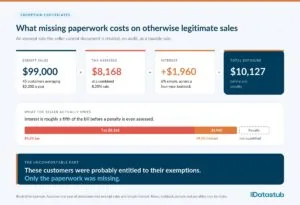
But when the certificate is missing, incomplete, or invalid, that protection is not there, and the uncollected tax becomes yours to pay.
THE CORE IDEA
The certificate moves the liability, it does not erase it
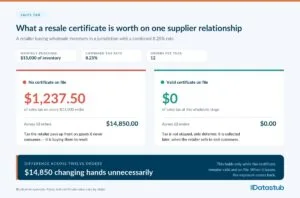
Tax does not go away when a certificate appears. Instead, responsibility for it moves from the buyer to you, and the certificate is what moves it back.
So a certificate is worth exactly as much as your ability to produce a complete, valid copy on the day someone asks for it.
Resale certificate or exemption certificate?
Both terms come up often, though they describe the same kind of document used in two different situations.
→ A resale certificate covers businesses buying goods they intend to resell. Tax gets collected later, when the end customer buys the item, so collecting it now would tax the same product twice.
→ An exemption certificate is the broader term. It covers resale along with other exemption types, including non-profits, manufacturers, and government agencies.
Some states issue one document for both. Others use separate forms. Either way, using the wrong type is treated exactly like having no certificate at all.
Who Qualifies for One
Just as product taxability by state varies more than most sellers expect, exemptions are narrow and specific. They turn on either who the buyer is or what the goods will be used for.
| Certificate type | Who uses it | Common example |
|---|---|---|
| Resale | Businesses buying goods to resell | Retailer buying wholesale inventory for their store |
| Manufacturing | Manufacturers buying materials for production | Factory buying raw steel that becomes a finished product |
| Non-profit | Qualifying charities and religious organizations | Registered charity buying supplies for exempt activities |
| Government | Federal, state, and local agencies | City government buying office furniture |
| Agricultural | Farmers buying equipment, seed, or feed | Farm buying a tractor or fertilizer |
| Direct pay permit | Large buyers with complex multi-state purchasing | Manufacturer that determines use only after purchase |
Resale is the type most sellers meet first. Still, anyone selling to schools, churches, government agencies, or manufacturers will see the others regularly, so it helps to recognize each one on sight.
WORTH KNOWING
A 501(c)(3) letter is not a sales tax exemption
Federal 501(c)(3) status is an income tax exemption granted by the IRS. It does not automatically exempt an organization from sales tax.
Each state decides separately which non-profits qualify, and many require their own application and their own certificate.
So a charity that hands you a federal determination letter has not given you what you need. Ask for the state-issued exemption certificate instead.
Which Form to Use
Sellers who have already worked through economic nexus rules will recognize the pattern here: every state sets its own requirements, and no single universal exemption certificate works everywhere.
That said, two multi-state forms cover a lot of ground and therefore cut the paperwork considerably.
| Form | Coverage | The catch |
|---|---|---|
| MTC Uniform Sales & Use Tax Resale Certificate | Accepted in roughly 36 to 38 states | Several states accept it only if the buyer is also registered in that state. Acceptance is not the same as exemption |
| Streamlined Sales Tax (SST) Certificate of Exemption | Accepted across the 24 SST full member states | Covers member states only. Check the current list before relying on it |
| State-specific certificate | The issuing state | Most states require their own form for at least some exemption types |
That first catch is the one that trips people up most. Listing a state on the MTC form does not exempt the purchase if that state also expects you to hold its own permit. Read the state footnotes printed on the back of the form.
States that require their own form
California, Florida, Hawaii, Illinois, Maryland, and Massachusetts are among the states that decline the MTC certificate. California is the strictest: buyers need a California seller’s permit and the state’s own form, CDTFA-230. Given how much commerce runs through California and Florida, anyone selling into either state should start with the state form rather than a multi-state one.
To find the right document, go to the state revenue department website and search for “resale certificate” or “exemption certificate.” Nearly every state publishes its forms free to download.
One prerequisite catches new sellers off guard: in most states, a buyer needs an active sales tax registration before issuing a resale certificate at all. You cannot claim you are buying for resale if you are not registered to collect tax on those resales.
What Has to Be on the Certificate
For ecommerce sellers processing certificates at checkout, this is the step worth automating, because an incomplete certificate carries the same weight as no certificate. Most states require at minimum:
✓ The buyer’s legal business name and address
✓ Their sales tax registration or seller’s permit number
✓ A description of the goods, or a clear statement that the certificate covers all purchases
✓ The reason for the exemption, such as resale, manufacturing, non-profit, or government
✓ A signature from someone authorized at the buyer’s organization
✓ The date
Several states ask for more, including the buyer’s type of business or the state where they hold registration. So the simplest fix is to use the official state form, because each one is built to capture everything that state expects.
Blanket certificates and per-transaction certificates
Buying from the same supplier repeatedly does not mean filing a new certificate every time. Instead, most states allow a blanket certificate covering all purchases from that supplier over a set period. Per-transaction certificates then handle one-off purchases, covering only the single sale named on them.
As a seller holding a blanket certificate, apply it to every qualifying order from that customer until it expires or their circumstances change.
When to Collect It, and What to Do If You Did Not
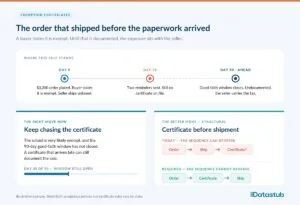
Sellers who have set up Amazon FBA bookkeeping know how quickly orders outrun paperwork, and exemption certificates are where that gap gets expensive. The clean answer is to collect the certificate at or before the sale.
When that does not happen, the position is far better than most sellers assume.
→ The common benchmark is 90 days. Streamlined Sales Tax states relieve a seller of liability when a fully completed certificate is obtained at the time of sale, within 90 days after it, or before the state begins an audit. New York, New Jersey, and Vermont apply the same 90-day window.
→ Once an audit starts, there is usually still a second window. North Carolina and New Jersey both give a seller 120 days after a request for substantiation to produce a fully completed certificate taken in good faith.
→ Auditors also apply the good-faith standard to corrected certificates covering transactions older than the 90-day window.
So chasing a missing certificate is worth doing, including after an audit notice arrives. Sellers who assume the door has closed often write off tax they were never going to owe.
Two practical notes. When you have already charged and remitted tax, refunding the customer and collecting a certificate afterward gets complicated and varies by state. And when a certificate arrives after you invoiced without tax, check that its date sits close enough to the transaction to satisfy that state.
How to Verify a Certificate
Any retail bookkeeping process handling exempt sales needs a verification step, because good-faith acceptance is what earns the protection. A certificate you had obvious reason to doubt does not qualify.
Good faith means the document looks legitimate and the purchase makes sense for that buyer. Here is what to check:
✓ Confirm the registration number is real. Most state revenue websites offer a free lookup that settles it quickly
✓ Match the certificate to the right state, since a California resale certificate does nothing for a Texas sale
✓ Compare the goods against the stated exemption reason. A restaurant using a resale certificate to buy office chairs does not add up
✓ Look for a signature and a date
✓ Verify the name on the certificate matches the customer actually making the purchase
None of this requires investigating your customers. You are expected to review what you receive and catch obvious problems, nothing more. When something does look off — a plumber claiming resale on office furniture, or a new customer presenting a certificate from a state they do not operate in — ask one question before skipping the tax.
GOOD FAITH
What the protection actually covers
A seller who accepts a complete certificate, confirms the permit number, and sees a purchase consistent with the buyer’s business is generally protected even when the buyer later turns out not to have qualified. The state pursues the buyer.
That protection rests on three things: you obtained a certificate, you reviewed it, and nothing on it raised an obvious problem.
How Long They Last and Where to Keep Them
Solid outsourced bookkeeping treats certificates as records with their own lifecycle, because expiration rules differ sharply from one state to the next.
→ Many states set no expiration at all, including California, New York, Texas, and Georgia. A certificate from 2019 still holds, provided the buyer’s information and circumstances have not changed
→ Some states set fixed periods. Alabama requires annual renewal. Washington reseller permits typically run four years, though newer or non-reporting businesses may receive only two
→ Arizona’s resale certificate itself does not expire, but blanket certificates should be refreshed at least every twelve months under state procedure
→ Florida deserves particular attention. Its Annual Resale Certificate is issued yearly and tied to the calendar year, so a 2025 certificate on file does nothing for a 2026 purchase no matter when it arrived
Expiration is only half of it. Even where a certificate never expires, it stops protecting you the moment the buyer’s situation changes. So a reseller who closes, drops that product line, or loses their registration leaves you holding a document that no longer describes reality.
Refreshing certificates every three to four years handles both problems at once, even in states that never require it.
How long to keep them
Retention runs on a different clock than validity. Set the floor at four years, which matches California’s requirement that sellers keep exemption certificates four years from the date of sale, and covers the typical three-to-four-year audit lookback in most states.
Sellers registered across many states should stretch that to five to seven years, since lookback periods extend when returns were never filed or when an auditor finds material errors. Keep certificates for active customers indefinitely, for as long as the relationship runs.
Digital beats paper
Paper works until it does not. After all, a certificate you collected but cannot locate at audit time protects you exactly as much as one you never collected. So:
- Scan and file every certificate the day it arrives, rather than batching it for later
- Organize by customer name and record any renewal date so refreshes surface on their own
- Higher-volume sellers should look at dedicated exemption certificate management software, which plugs into most ecommerce platforms and automates renewal requests
A shared drive folder organized by customer handles this perfectly well for sellers with a handful of exempt accounts. The only real test is whether any certificate can be found in under a minute when someone asks for it.
Using Certificates as the Buyer
Everything above sits on the seller’s side of the counter. Businesses handling their own business tax preparation will also issue certificates as buyers, where the process is simpler but no less exact.
1. Register in the state first
Most states expect an active sales tax registration before you can issue a resale certificate. Claiming resale exemption without being registered to collect tax on those resales does not hold.
2. Match the form to your supplier’s state
A Texas supplier takes a Texas resale certificate or an accepted multi-state form. A California supplier needs California’s own form, since the MTC certificate does not work there.
3. Complete it fully
Business name, address, permit number, what you are buying, and the exemption reason. Sign it and date it. An incomplete certificate offers you nothing.
4. Send it before the purchase
Get the certificate to your supplier before the order processes, rather than paying tax first and trying to recover it afterward.
5. Keep your own copy
Record what you issued, what it covered, and when. Should your supplier ever face an audit that questions your exemption, you will want that documentation on your side.
6. Use it only for qualifying purchases
A resale certificate covers goods you will resell. It does not stretch to office supplies, furniture, tools, or anything else the business consumes. Misuse pushes the liability straight back to you.
Common Mistakes to Avoid
These are the ones that surface most often in certificate reviews:
✕ Accepting a verbal exemption claim, which documents nothing and protects no one
✕ Using the MTC uniform certificate in California or Florida, where it is not accepted
✕ Assuming the MTC form works in a listed state without checking whether that state also requires local registration
✕ Treating a federal 501(c)(3) letter as a state sales tax exemption
✕ Accepting an out-of-state certificate for a sale sourced somewhere else
✕ Issuing a resale certificate for goods the business will actually consume
✕ Overlooking Florida’s calendar-year renewal, which quietly invalidates last year’s certificate
✕ Storing paper certificates with no backup copy
✕ Letting long-term customer certificates go stale as their businesses change
✕ Writing off a missing certificate as unrecoverable when the 90-day or 120-day window is still open
Final Thought
Certificates sit alongside outsourced tax planning as one of the highest-return, lowest-effort areas of sales tax work. The mechanics are not complicated: right form, right timing, quick verification, findable storage.
Storage and renewal are where most businesses slip. Certificates collected enthusiastically at the start of a customer relationship get buried, and then three years later somebody needs them all at once. A shared folder organized by customer name closes most of that gap on its own. Once manual tracking starts to strain, software that automates collection and renewal earns its cost quickly.
At Datastub, we help sellers set up their exemption certificate process and review existing certificate files well before an auditor does. Reach out for a free consultation.
Would your exemption certificates hold up in an audit?
We will review your certificate file and tell you straight where the gaps are. Free consultation, no pressure.
Disclaimer: This article is for general information only and does not constitute tax or legal advice. Exemption certificate requirements, renewal rules, and audit lookback periods vary by state and change over time. Always verify current rules with the relevant state’s Department of Revenue before acting on an exemption claim.