

A business capitalized $200,000 in domestic research costs on its 2023 return, exactly as the law required at the time (common for ecommerce, product-development, and engineering-heavy businesses alike). By the end of 2024, roughly $60,000 of that had been amortized. The remaining $140,000 is still sitting on the balance sheet, and the company has one return left to decide what happens to it: the 2025 return, due now.
That timing is not incidental. If this business is organized as a partnership or S corporation, its extended 2025 return was due today, September 15. If it’s a C corporation or a sole proprietor filing on Schedule C, it has until October 15. Either way, the decision about that $140,000 has to be made before the return goes out, not after.
Here’s what actually changed, what’s no longer an option, and what’s still worth deciding carefully.
What Actually Changed Under Section 174A
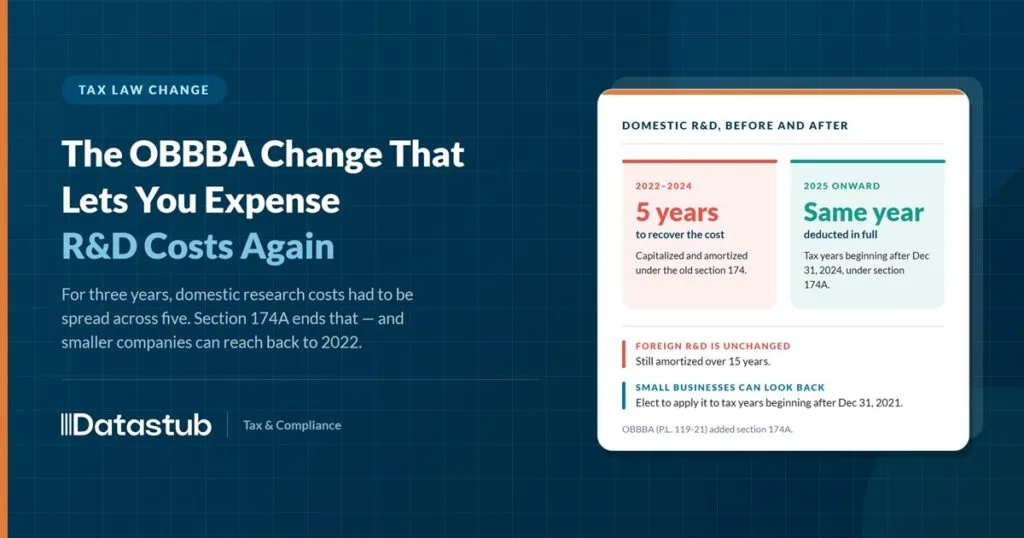
Starting in 2022, the Tax Cuts and Jobs Act required businesses to capitalize domestic research and experimental costs and amortize them over 5 years, and foreign research costs over 15 years, instead of deducting them the year they were incurred. It was an unpopular rule that effectively taxed R&D-heavy businesses on money they’d already spent.
The One Big Beautiful Bill Act, signed July 4, 2025, created new Section 174A and reversed that rule for domestic research costs. For any tax year beginning after December 31, 2024 (in practice, the 2025 tax year forward), a business can choose between two paths for its ongoing domestic R&D spending:
| Path | What it means |
|---|---|
| Immediate expensing (Section 174A(a)) | Deduct domestic R&D costs in full, in the year you spend the money |
| Elective capitalization (Section 174A(c)) | Capitalize and amortize the costs over a period you choose, of at least 60 months |
Foreign research costs are unaffected. They still amortize over 15 years, full stop.
That part of the change is straightforward and permanent. The part that’s confusing almost everyone right now is what happens to the money already capitalized under the old rule in 2022, 2023, and 2024.
The Door That Already Closed
The law gave smaller businesses, those with average annual gross receipts of $31 million or less over the prior three years, a special option: go back and amend the 2022, 2023, and 2024 returns to apply the new expensing rules retroactively, potentially generating a real cash refund.
That option came with a hard deadline. Under Rev. Proc. 2025-28, the IRS’s own procedural guidance, eligible small businesses had until July 6, 2026 to file those amended returns or amended partnership returns. That date has already passed.
If your business qualified for the retroactive election and didn’t file by then, that path is gone. It isn’t a matter of finding time to still get it done. The deadline was a hard outer limit, and going back to claim a refund on 2022 through 2024 returns is no longer available.
That’s worth saying plainly, because most of what’s published on this topic was written before the deadline passed and still describes amending as a live option. It isn’t one anymore.
The Decision That’s Still Live: Your 2025 Return
Here’s the part that gets missed: the retroactive amendment being closed doesn’t mean the unamortized balance is stuck. Every business, regardless of size, gets to decide how to treat whatever’s left of its 2022-2024 domestic R&D capitalization on the return for the first tax year beginning after December 31, 2024, which for a calendar-year filer is the 2025 return. That choice applies whether or not you ever qualified for the small-business amendment option.
There are three ways to handle it:
- Deduct the entire remaining balance on the 2025 return. One large deduction, taken now.
- Split it ratably across the 2025 and 2026 returns. Half this year, half next.
- Keep the original 5-year amortization schedule running. No acceleration, just business as usual.
Which one makes sense depends on where your income actually falls in 2025 and 2026, not on which option sounds most generous on paper.
A worked example
Back to the $140,000 remaining balance. Here’s how the three paths play out, assuming similar taxable income in both years:
| Path | 2025 deduction | 2026 deduction | Best fit when |
|---|---|---|---|
| Full deduction now |
$140,000 |
$0 |
2025 income is high and the business needs to offset it now |
| Two-year spread |
$70,000 |
$70,000 |
Income is expected to be similar in both years, with no strong reason to front-load |
| Continue amortizing |
Roughly $28,000 |
Roughly $28,000 |
Income is currently low or uncertain, and a large net operating loss isn’t useful right now |
A lean 2025 and a strong 2026 favor spreading the deduction, or even holding to the original schedule, over taking the full $140,000 now against income that isn’t there yet.
The Section 280C piece nobody explains simply
If this business also claims the federal R&D tax credit, there’s a coordination rule that catches people off guard: you can’t claim the full deduction and the full credit on the same dollars. Under Section 280C, claiming a $10,000 research credit means reducing the R&D expense deduction by that same $10,000, unless you make a separate election under Section 280C(c)(2) to claim a reduced credit instead and keep the deduction intact.
In plain terms: decide the deduction and the credit together, not one after the other. Running them separately is how businesses end up leaving value on the table without realizing it until the return is already filed.
A Timeline of How We Got Here
| Date | What happened |
|---|---|
| 2022–2024 | Domestic R&D costs required to be capitalized and amortized over 5 years under the TCJA rule |
| July 4, 2025 | OBBBA signed into law, creating Section 174A |
| August 28, 2025 | IRS issues Rev. Proc. 2025-28, the procedural guidance for implementing the change |
| September 15, 2026 | Extended deadline for calendar-year partnership and S corporation 2025 returns |
| July 6, 2026 | Deadline for the small-business retroactive amendment election. This date has passed |
| October 15, 2026 | Extended deadline for calendar-year C corporation and individual (including sole proprietor) 2025 returns |
Five Mistakes We’re Seeing Right Now
Assuming the amendment window is still open. It closed July 6, 2026. If your accountant is still describing this as a live option, ask when they last checked.
Missing which deadline actually applies to your entity. Partnerships and S corporations were on a September 15 clock. C corporations and sole proprietors have until October 15. Confusing the two means either rushing unnecessarily or running out of time.
Treating the $31 million threshold as if it limits every option. It limits who could retroactively amend 2022-2024 returns. It does not limit who can choose how to treat their unamortized balance on the 2025 return, that choice is open to businesses of every size.
Deciding the deduction and the R&D credit separately. The Section 280C coordination has to happen at the same time, not as an afterthought once the credit is already calculated.
Treating foreign R&D like domestic R&D. Nothing changed for foreign research costs. They still amortize over 15 years regardless of what you do with the domestic balance.
What to Decide Before You File
- Confirm your entity type and its actual deadline. Partnership or S corporation, that was September 15. C corporation or sole proprietor, you have until October 15.
- Calculate the exact unamortized balance sitting from 2022-2024 domestic R&D capitalization. This is a real number your tax team should already have on hand.
- Model the full deduction against the two-year spread, using your actual expected income for both years, not a rough guess.
- Coordinate the decision with any R&D tax credit you’re claiming, before either number gets finalized on the return.
- Get the decision into the return before it’s filed. Once it’s submitted, changing the treatment means amending, and that process is slower and more expensive than deciding correctly the first time.
The Real Decision Here
The interesting question was never “can I still amend.” That door is shut, and no amount of urgency changes that. The interesting question is whether the deduction you already have gets used to actually reduce a tax bill that matters, or gets taken reflexively in whichever year is easiest to file, regardless of what your income actually looks like.
That’s a timing decision, not a compliance checkbox, and it’s exactly the kind of decision that’s easy to get wrong when a return is being finished under deadline pressure. We help businesses work through the full deduction, right down to the 280C coordination and the entity-specific deadline, before the return goes out, not after. If your 2025 return still has this decision open, reach out to Datastub and we’ll walk through the numbers with you.
This article is for general informational purposes and does not replace advice from your CPA or tax advisor. Tax treatment depends on your specific facts, entity structure, and filing history, and OBBBA guidance continues to develop. Consult a qualified professional about your situation. For the IRS’s own guidance on this change, see Treasury and IRS guidance on accounting methods for research or experimental expenditures.