

You have formed a U.S. LLC from abroad. You need a tax ID to open a bank account and file whatever the IRS expects. Then the research starts, and the advice splits in two.
Half the sources say get an ITIN first, then use it to apply for the EIN. The other half say the EIN comes first and the ITIN may never be needed at all.
The second group is right, and the IRS says so directly. Sorting out which number does what saves weeks of waiting on an application you probably did not have to file.
Three Numbers, Three Different Jobs
Sound foreign-owned business accounting starts by keeping these separate, because the confusion between them causes most of the delay founders experience.
| Number | Identifies | Issued on | Who needs it |
|---|---|---|---|
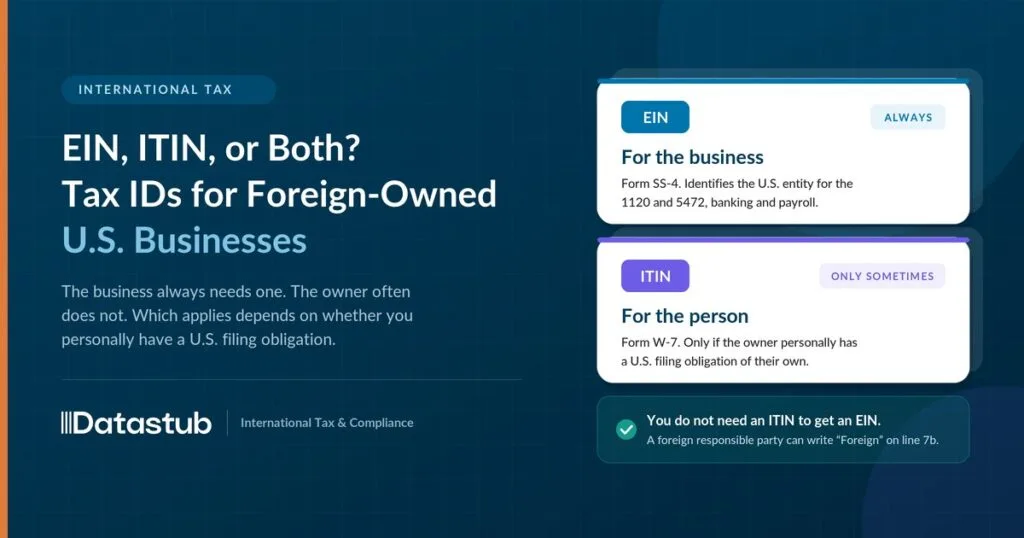
| EIN | Your business | Form SS-4 | Every U.S. entity with a filing, banking, payroll, or withholding need |
| ITIN | You personally | Form W-7 | Individuals with a U.S. filing obligation who cannot obtain an SSN |
| SSN | You personally | Social Security Administration | U.S. citizens and certain visa holders. Not available to most foreign owners |
| FTIN | You personally | Your home country | Reported on certain U.S. forms. Not issued by the IRS at all |
The distinction that matters most: an EIN identifies the entity, an ITIN identifies a person. They come from different forms, follow different processes, and answer different questions. Neither is a prerequisite for the other.
Your LLC Needs an EIN. You Probably Do Not Need an ITIN First.
This single point resolves most of the confusion that reaches us during international compliance work with newly formed entities. Internal IRS guidance states it plainly: foreign individuals are not required to have an ITIN in order to receive an EIN.
Form SS-4 line 7b asks for the responsible party’s SSN or ITIN. Where that person has neither and cannot obtain either, the instructions direct you to enter “foreign” or “N/A”. You must enter something, so never leave the line blank, though it does not have to be a number.
So the sequence most founders are sold, ITIN first and EIN second, adds a seven-week application to the front of a process that did not require it.
THE MYTH AND THE RULE
Where the bad advice comes from
The IRS online EIN tool does require the responsible party to hold an SSN or ITIN, and it also requires a U.S. principal place of business. Both conditions fail for most foreign founders.
Because the online tool is the route nearly every article recommends first, its requirements get reported as though they were the rule for everyone.
They are not. They are the eligibility conditions for one submission channel. The other channels have different rules, and those are the ones foreign applicants use.
How a Non-Resident Actually Gets an EIN
The mechanics are straightforward once you stop trying to use the online system, and they fit neatly into standard entity setup and bookkeeping onboarding. Three channels are open to international applicants.
| Channel | Typical turnaround | Notes |
|---|---|---|
| International phone line | Often assigned on the call | 267-941-1099, weekdays. The IRS may ask for a signed Form SS-4 afterwards |
| Fax | Around four business days | Include a return fax number. Confirm the current number on the Form SS-4 instructions, since domestic and international lines differ |
| Four to six weeks | IRS, Attn: EIN International Operation, Cincinnati, OH 45999 |
Three rules govern all three channels. Use only one method per entity, because duplicate applications create duplicate records. The entity must already exist before you apply. And the IRS issues one EIN per responsible party per day.
Your EIN assignment letter, Form CP 575, goes to the address on the application. Save it, because the IRS does not reissue it.
Who Can Be the Responsible Party
This is the most common reason an application fails, and it is worth settling before anyone files. A virtual CFO review of a new entity should confirm it at formation rather than at application.
- The responsible party must be a natural person. An LLC or corporation cannot occupy the role
- That person must actually own or control the entity or its funds. Neither a formation agent nor a nominee qualifies, and the IRS says nominees should not apply
- They must appear by name on the application, since the role does not accept a generic entry
- Report any later change on Form 8822-B, within 60 days where the responsible party changes
Formation services sometimes list themselves here to speed things along. That creates a record the IRS does not accept, and someone then has to correct it. So check what went in on your behalf if a third party obtained your EIN.
When You Genuinely Do Need an ITIN
An ITIN becomes necessary when you personally have a U.S. filing obligation, which is a narrower situation than most founders assume. This is where individual tax support and entity-level work diverge.
You generally need one when a specific U.S. form requires it, not as a precaution. Typical triggers include filing a personal U.S. return such as Form 1040-NR, being claimed on a return, or a partnership reporting requirement where you are a partner in a U.S. LLC taxed as a partnership.
Applying means Form W-7, supported by original or agency-certified proof of identity and foreign status. You cannot e-file a W-7, and it normally travels with the return that created the need. The IRS quotes roughly seven weeks, stretching to nine or eleven during the January to April peak and for applicants abroad. A Certifying Acceptance Agent can also verify documents in person, so you keep your passport rather than mailing it.
One recent procedural change is worth flagging for anyone applying as a partner in a U.S. LLC. From June 1, 2026, Certifying Acceptance Agents submitting a W-7 under the partnership exception must include a copy of the partnership or LLC agreement showing the entity name, its EIN, and the applicant’s name and signature, along with evidence that the partnership is conducting business in the United States. Get the operating agreement signed and naming you clearly before starting.
What Form 5472 Actually Asks For
This deserves its own section because the advice online is contradictory, and getting it wrong sends founders after a number they do not need. The FBAR filing rules create a similar confusion, where an obligation is assumed rather than checked.
A foreign-owned single-member LLC files Form 5472 attached to a pro forma Form 1120. The form then asks for a foreign taxpayer identification number covering each direct and ultimate foreign owner.
That means your home-country tax number, not an ITIN. And where you have none, the instructions direct you to enter “None” or “N/A”. The form still counts as complete.
WORTH BEING CLEAR ABOUT
An ITIN is not required to file Form 5472
Several widely circulated articles state that a foreign LLC owner needs an ITIN for Form 5472, sometimes alongside a warning about the $25,000 penalty for not filing.
The penalty is real. The ITIN requirement is not. What the LLC needs is its own EIN. What the form asks of you personally is a foreign taxpayer identification number, with “None” or “N/A” accepted where none exists.
The practical risk runs the other way. A founder who believes an ITIN must come first may delay filing while waiting on a W-7, and a late Form 5472 carries the penalty that the ITIN was never going to prevent.
An ITIN becomes relevant only if you separately have a personal U.S. return to file.
ITINs Expire, and Owners Find Out Late
If you already hold an ITIN, this is the detail that catches people at filing time, and it belongs on the same annual checklist as your year-end close rather than being remembered in April.
An ITIN that has not appeared on at least one U.S. federal return for three consecutive tax years expires on December 31 of that third year. You must then renew it before using it again. Any ITIN issued before 2013 that nobody ever renewed also needs a renewal application.
Renewal uses the same Form W-7 with the renewal box checked and the same documentation rules, so it takes as long as a first application. The IRS will still process a return carrying an expired ITIN, though it holds back credits and exemptions until the renewal completes.
Watch for one pattern in particular. A founder obtains an ITIN years ago for a single filing, then files no personal U.S. return for several years. That number quietly expires, and the discovery usually lands in filing season with no time left to fix it.
Common Mistakes
These recur across new foreign-owned entities:
- Applying for an ITIN before the EIN, on the belief that one requires the other
- Attempting the online EIN tool, which is closed to applicants without a U.S. principal place of business and a responsible party holding an SSN or ITIN
- Leaving line 7b blank instead of entering “foreign” or “N/A”
- Naming a formation agent or an entity as the responsible party
- Submitting through two channels at once to speed things up, which creates duplicate records
- Applying for the EIN before the entity legally exists
- Chasing an ITIN for Form 5472 when the form accepts “None” or “N/A” for a foreign taxpayer number
- Delaying a Form 5472 filing while waiting on an ITIN, which risks a penalty the ITIN would not have avoided
- Assuming an old ITIN is still valid after several years without a U.S. return
- Failing to file Form 8822-B within 60 days after the responsible party changes
Final Thought
Two questions settle almost all of this, and answering them early keeps ecommerce and startup bookkeeping moving instead of stalled behind an application.
Does the entity need a tax ID? Then it needs an EIN, obtainable now, without an ITIN, through the phone, fax, or mail route. Do you personally have a U.S. return to file? Only then does an ITIN enter the picture, and it follows the return rather than preceding it.
Most foreign founders need the first and never the second. The ones who do need both are better off knowing which is which before either application starts.
Setting up a U.S. entity from abroad, or unsure whether your filings are in order? Reach out to Datastub. We will confirm what your entity actually needs and what it does not.
| Not sure which tax IDs your U.S. entity actually needs?
We will confirm what your entity needs, what you need personally, and what you can skip. Free consultation, no pressure. |