

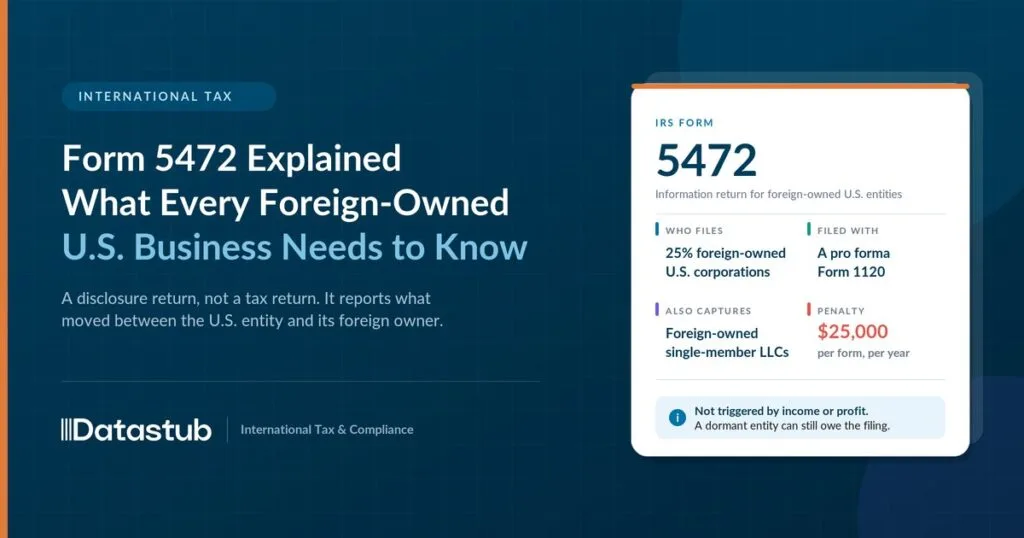
Does a foreign person own part of your U.S. company? Then you likely owe the IRS one form every year. It is called Form 5472.
The form charges no tax. It sends you no bill. Most owners never hear about it until year three. And it is short – an afternoon of work, once you know the rules.
This guide covers the whole thing. Who files, what counts, when it is due, and how to keep it running quietly in the background.
The Short Version: Who Files Form 5472, and When
Here is the answer before the detail. See how EIN and ITIN differ for foreign-owned LLCs.
| Question | Answer |
|---|---|
| Who files? | A U.S. company that is 25% or more foreign-owned, and had dealings with its owner |
| Does it cost tax? | No. It reports. It does not calculate |
| When is it due? | With your income tax return – April 15 for most, October 15 with an extension |
| How many forms? | One for each related party you dealt with |
| Can I e-file? | Not if you are a single-member LLC. Fax or mail only |
| What if I skip it? | $25,000 per form, per year |
Now the detail.
What Form 5472 Actually Does, and Why the IRS Wants It
Anyone handling international tax preparation for a foreign-owned entity meets this form early. Form 5472 is an information return. Put simply, it reports rather than calculates.
It tells the IRS two things. First, this U.S. company has a foreign owner. Second, here is the money that moved between them.
The reason is visibility. Without the form, the IRS cannot easily see what passes between a U.S. company and the people who own it from abroad.
That gap opened in the early 1980s, when foreign investment into the U.S. climbed fast. A U.S. parent had to disclose its dealings with a U.S. subsidiary. A foreign parent disclosed nothing. So a foreign parent could charge its U.S. company whatever it liked for goods, services, or loans. That made the U.S. company look less profitable and moved money out of U.S. tax reach.
Congress closed the gap in stages. Section 6038A arrived with the 1982 law known as TEFRA. Lawmakers tightened it in 1989. Then Section 6038C followed in 1990, covering foreign companies that operate here directly.
Who Has to File Form 5472: Two Very Different Businesses
Two very different businesses land on the same form. Business tax preparation for a foreign-owned company starts by working out which one you are.
U.S. Companies That Are 25% Foreign-Owned or More
You file if a foreign person owns at least 25% of your U.S. company and you had dealings with a related party during the year.
This covers two entity types. A regular U.S. corporation. And a single-member LLC that the IRS ignores for income tax – known as a disregarded entity, or DE for short.
Three details decide most cases:
- Timing. You only need to cross 25% at some point in the year. One day counts, and it pulls in the whole year.
- Indirect ownership counts. A foreign company that owns a company that owns your LLC still triggers the rule. Also, the 25% can be measured by voting power or by value. Whichever crosses first wins.
- Family adds up. A husband at 15% and a wife at 12% count as 27% together. That clears the line.
Foreign Companies That Do Business in the U.S. Directly
A company formed outside the U.S. that trades directly inside it also files. It reports its dealings with related parties, same as above.
This route is less common. Most foreign groups run through a U.S. subsidiary instead.
The 2016 Rule That Pulled Single-Member LLCs Into Scope
Corporations carried this duty for decades. Single-member LLCs did not – until the IRS issued final regulations T.D. 9796 on December 13, 2016.
Worth noting: it was those regulations that brought foreign-owned LLCs into scope. Not the Tax Cuts and Jobs Act, which passed a year later. Plenty of articles still get this wrong.
Read the effective date closely. The rule covers tax years that begin on or after January 1, 2017 and end on or after December 13, 2017.
For this one purpose, the IRS treats your LLC as a corporation. You file a stripped-down Form 1120 purely as something to staple Form 5472 to. No tax gets calculated on it.
What Counts as a Reportable Transaction, Cash or Not
For sellers running ecommerce bookkeeping across borders, this section decides how much work the filing takes.
A reportable transaction is any exchange between your U.S. company and a related party. Size does not decide whether it goes on the form.
Size does affect how you report it, though. Two breaks help here:
- When an amount, or a run of amounts, totals $50,000 or less, you may report it as “$50,000 or less.” No exact figure needed.
- When you cannot pin down the exact number, a reasonable estimate works. The IRS defines that as anything between 75% and 125% of the real figure.
Either way, the transaction still goes on the form. You just do not have to rebuild it to the cent.
Reportable Deals Where Cash Actually Moved
These are the obvious ones:
- Buying or selling goods with a related party
- Rent paid or received
- Royalties for use of a trademark, patent, or other intellectual property
- Interest on loans between the company and its owner
- Management fees paid to the foreign owner
- Money the owner puts in
- Profit sent back out
Reportable Deals Where No Cash Moved at All
These surprise owners most, because nothing shows up in the bank statement to remind them:
- An interest-free loan from the owner. The interest that could have been charged is itself reportable.
- Free use of the owner’s trademark or patent. You report the value of that use.
- Unpaid work by the owner, whether bookkeeping, marketing, or management.
- Property moving between owner and company with nothing paid for it.
A Quiet First Year That Still Needs Two Forms
Take a newly formed foreign-owned LLC with $95,000 of revenue in year one. On paper, nothing eventful happened. Underneath, five reportable items did.
| What happened | Amount | Related party |
|---|---|---|
| Start-up funding wired in by the owner | $30,000 | The owner |
| Management fee paid back to the owner | $18,000 | The owner |
| Three later transfers to cover costs | $22,000 | The owner |
| Bookkeeping done by the owner, unpaid | $6,000 | The owner |
| Product photos shot free of charge by a company the owner also controls | $4,000 | That company |
Every line belongs on Form 5472. The unpaid bookkeeping and the free photography sit in the non-monetary section, even though no cash moved.
And because that second company is a separate related party from the owner personally, this year needs two Forms 5472. Not one.
That is the piece owners miss most often. Count your related parties before you start.
When and How to File Form 5472, Step by Step
Clean outsourced bookkeeping makes this filing almost mechanical. The hard part is having the transaction record ready – not filling in the form.
Form 5472 attaches to your income tax return. It follows that return’s due date, extensions included.
A regular U.S. corporation files it alongside Form 1120 and can e-file both together. A foreign-owned single-member LLC takes a stricter path:
- Prepare a pro forma Form 1120. You only complete the entity name and address, plus items B and E on page one.
- Write “Foreign-Owned U.S. DE” across the top of that Form 1120.
- Attach one Form 5472 for each related party you dealt with during the year.
- Send it by fax to 855-887-7737. Or mail it to Internal Revenue Service, 1973 Rulon White Blvd, M/S 6112, Attn: PIN Unit, Ogden, UT 84201.
That last step matters. E-filing is not available to these entities, and this dedicated address replaces the usual Form 1120 address.
Getting an Extension: The Form 7004 Address Trap
Form 7004 buys the usual six months. A calendar-year filer moves from April 15 to October 15.
Two details catch people out. First, enter the Form 1120 code on Form 7004, Part I, line 1, and write “Foreign-Owned U.S. DE” across the top of the 7004 as well. Second, fax or mail the 7004 to that same dedicated Ogden address – not the standard Form 7004 address. Sent to the usual place, an extension can simply fail to register.
One more assumption worth checking. Your tax year is not automatically the calendar year. The entity takes the same tax year as its foreign owner, where that owner has a U.S. filing obligation. It defaults to the calendar year only when there is none.
Common Questions About Filing Form 5472
Does Form 5472 Go on My Personal Return?
No. It never attaches to a Schedule C, a Form 1040, or any individual return. It belongs to a corporate return – either a real Form 1120 or a pro forma one.
Do I Need an ITIN to File Form 5472?
Usually not. This question causes more confusion than any other on the form.
Form 5472 asks for a foreign tax ID number for each direct and ultimate foreign owner. Where the owner has none, you enter “None” or “N/A” and the form is still complete.
Your LLC does need its own EIN. An ITIN becomes necessary separately, and only if the owner has a personal U.S. return to file.
Do I Still File in a Year With Almost No Activity?
Almost always, yes. An exception exists, but it is narrow. It applies only where you had no reportable transactions under Parts IV, V, and VI.
Part V reaches very wide. It covers formation, money in, and money out. A genuinely empty year is therefore rare. And since the funding that started the LLC is itself reportable, year one almost never qualifies.
Which of the Nine Parts Do I Actually Fill In?
The form runs to nine parts, laid out in the IRS instructions for Form 5472. Most filers touch a handful.
| Part | Covers | Who completes it |
|---|---|---|
| I | The reporting company | Everyone |
| II | The 25% foreign shareholder | 25% foreign-owned companies, DEs included |
| III | The related party | Everyone, even where it repeats Part II |
| IV | Monetary transactions | Where cash moved with a foreign related party |
| V | Other DE transactions | Foreign-owned DEs. A checkbox plus a written statement |
| VI | Non-monetary and part-payment transactions | Where value moved without full payment |
| VII | Additional information | Everyone. This one is mandatory |
| VIII | Cost sharing arrangements | Rare for small filers |
| IX | Base erosion payments | Rare for small filers |
Two deserve a second look. Part V is a checkbox, not a figures section, and it needs a separate written statement covering formation, money in, and money out. Part VII is mandatory for every filer, so the form does not end at Part VI.
What If I Am Already Behind on Past Years?
You are in good company. Discovering this late is very common, and tax planning support at this stage is mostly about sequencing the catch-up properly.
The route has changed, though. Until November 2020, the Delinquent International Information Return Submission Procedures effectively guaranteed a waiver for taxpayers who qualified. The IRS withdrew that automatic waiver.
Today the position is different. If you are not under examination and the IRS has not contacted you about the delinquency, you file through normal procedures. You attach the delinquent returns to an amended return. Penalties may still be assessed.
In practice, that means you argue reasonable cause rather than receive it up front. Often you argue it after a notice arrives. A well-documented submission still succeeds regularly.
Here is what a catch-up looks like:
- Prepare a pro forma Form 1120 for every year you missed.
- Complete a Form 5472 for each related party, in each of those years, with every transaction captured.
- Write a reasonable cause statement. Say specifically why the filings were missed, and back it with dates and documents rather than assertions.
- File before the IRS makes contact. Coming forward first carries real weight, and that advantage disappears once a notice lands.
- Keep the full package on file. You may need to respond again later.
What Missing Form 5472 Actually Costs
One number, then the detail in a table, then we move on.
Missing the form costs $25,000 per form, per year. Filing something substantially incomplete counts as not filing at all.
| Situation | Amount |
|---|---|
| Failure to file, per form, per year | $25,000 |
| Substantially incomplete form | Treated as a failure to file |
| Failure to keep the required records | $25,000 |
| Each 30-day period past 90 days after IRS notice, per related party | +$25,000 |
| Two related parties, two missed years, before continuation | $100,000 |
| Ceiling on continuation penalties | None |
Timing works differently here too. Under section 6501(c)(8), the assessment window stays open until three years after you actually furnish the missing information. An unfiled year does not quietly age out, because the clock never starts.
What the 2024 Farhy Decision Did and Did Not Settle
In May 2024 the D.C. Circuit reversed the Tax Court in Farhy v. Commissioner. It held that the IRS may assess and collect these penalties directly, without suing the taxpayer first.
Two limits matter. Farhy concerned Form 5471 under section 6038(b) – not Form 5472 under section 6038A. Commentators note that assessability appears to be settled statute by statute. Meanwhile the Tax Court has reaffirmed its opposite view in Mukhi, which still binds taxpayers outside the D.C. Circuit.
Here is why it matters for this audience anyway. The D.C. Circuit covers taxpayers who live outside the United States. That describes most foreign owners of U.S. LLCs. For them, the friendlier reading is the one that does not apply.
The takeaway does not change. Treat the penalty as collectible and file on time.
Records: What to Keep, and for How Long
Sound foreign-owned business accounting treats the records as the real deliverable. The IRS can ask you to back up every figure on the form, and a filing you cannot support counts as incomplete.
The standard in the law is simple. Your records must be enough to establish that the return is correct. No fixed retention period appears in the rule, so treat this as our working guidance: keep everything for seven years. The assessment window stays open on any year you never filed.
Keep these:
- Bank transfer records showing amount, date, and direction
- Invoices and agreements for services given or received
- Management fee agreements covering the arrangement, not just the payment
- Records of money the owner put in, with dates
- Records of money sent back out, with dates
- Written agreements behind non-cash items, covering trademark use, unpaid work, or property transfers
- Loan agreements with terms, rates, and repayment schedules
Non-cash items need a dollar figure too, at fair market value. The $6,000 of unpaid bookkeeping above goes on the form as $6,000, and you need support for how you reached that number. Setting the value in writing before the work happens beats reconstructing it a year later.
The One Relief Foreign-Owned LLCs Do Not Get
Regular small corporations get two breaks from the full record-keeping rules. One applies under $10 million in U.S. gross receipts. The other is a de minimis break, where related-party transactions stay under $5 million and account for less than 10% of the company’s U.S. gross income.
Neither reaches a foreign-owned disregarded entity. A one-person LLC with $95,000 of revenue carries the same record-keeping duty as a company a thousand times its size.
The smallest filers get the least relief. That is the opposite of what most owners assume.
Ten Form 5472 Mistakes Worth Avoiding
- Assuming a disregarded entity is exempt because the IRS ignores it for income tax
- Reading zero revenue as zero filing, when the funding alone is reportable
- Filing one Form 5472 to cover several related parties, instead of one per party
- Reporting cash movements only, and leaving out unpaid work or interest-free loans
- Trying to e-file a foreign-owned disregarded entity return, which the IRS cannot accept
- Sending Form 7004 to the standard extension address rather than the dedicated one
- Stopping at Part VI and leaving the mandatory Part VII blank
- Keeping no support for the figures reported, which alone renders the filing incomplete
- Treating Form 5472 and FBAR filing requirements as the same thing, when one company can owe both
- Waiting for the IRS to make contact before filing late years
Do You Need to File? A Quick Decision Check
Work down the list. Stop at your first yes.
Does a foreign person own 25% or more of your U.S. company, at any point this year?
No, you are clear for this year. Check again if ownership changes. Yes – keep going.
Did any money, property, or service pass between the company and that owner, or anyone related to them?
No, you may qualify for the narrow exception. Confirm it, do not assume it. Yes, you file. Keep going.
How many separate related parties did you deal with?
That is your number of forms. One each, every year.
Are you a single-member LLC?
Yes, pro forma 1120, “Foreign-Owned U.S. DE” across the top, fax or mail to Ogden. No e-file. No – file it with your Form 1120 as normal.
Have you missed prior years?
Yes, start the catch-up now, before any notice arrives. That timing is worth real money.
Form 5472 is easy to miss precisely because it behaves unlike the filings owners expect. It produces no bill. It rarely comes up in ordinary tax conversations. And it attaches to entities people chose because they looked simple.
The filing itself, though, is short and entirely manageable. The work is in the record-keeping, and that work pays off in every other part of the business too.
If your U.S. company has foreign ownership of any size, direct or indirect, the question is not whether you probably need to file. It is whether you have confirmed someone is handling it.
Not sure whether your foreign-owned U.S. company has a Form 5472 obligation?
Send us your ownership structure and a year of transactions. We will tell you straight what is required, what is missing, and what it takes to catch up. Free consultation, no pressure.