

If you run a roofing, HVAC, plumbing, or electrical business, January usually starts with a paperwork chase. You track down W-9s, add up what you paid every sub and helper, and send out a stack of 1099s.
For 2026, there’s good news: that stack gets smaller.
A new federal law raised the dollar threshold that decides who gets a 1099 — the first real change in decades. Fewer subcontractors and vendors will need a form, which makes January easier for any contractor who pays a lot of people small amounts.
A few things didn’t change, though, and they matter just as much. This guide covers what’s new, what stayed the same, and a simple checklist to get your 2026 forms done right.
The Change 1099-NEC & 1099-MISC
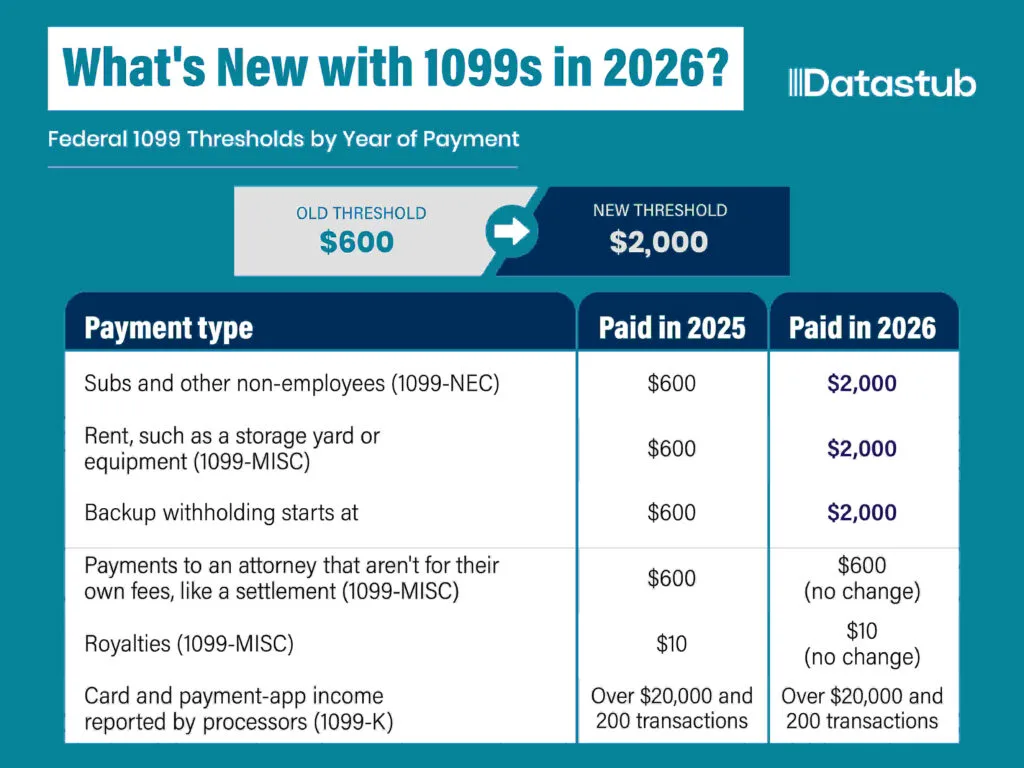
The 1099 limit went up from $600 to $2,000. For payments you make in 2026, you only send a 1099 to someone you paid $2,000 or more during the year.
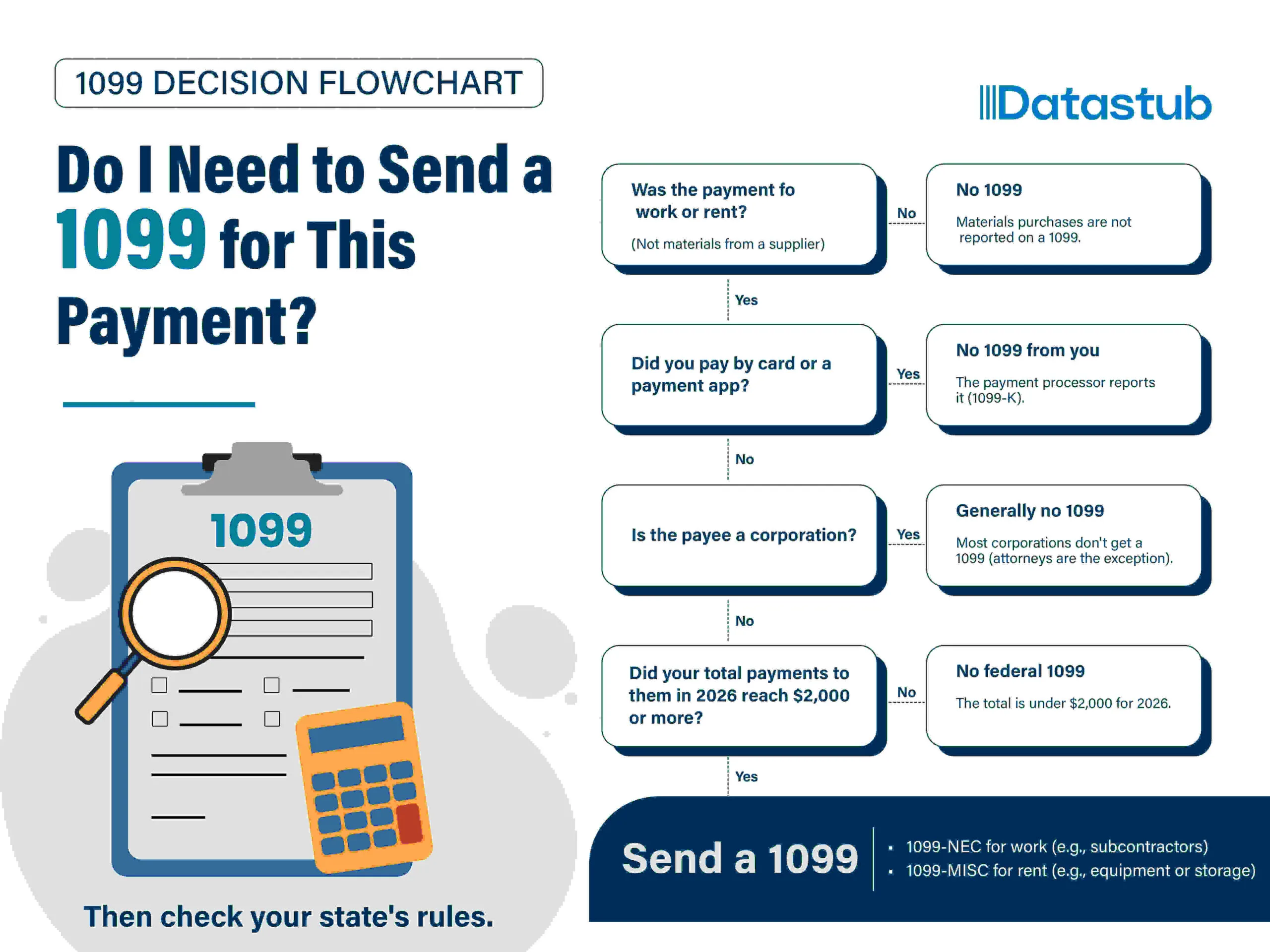
That’s per person, per year. Make the total amount you paid to the subcontractor from January 1 to December 31. If the total is $2,000 or more, they get a 1099. If it’s less, they don’t — at least not a federal one.
Three details to get right:
- It’s about when you paid, not when you file. The 1099s you sent in January 2026 covered 2025 payments, so they still used $600. The new $2,000 line starts with the forms you file in early 2027.
- The deadline is February 1, 2027. It’s normally January 31, but that falls on a Sunday in 2027. The IRS copy and your sub’s copy are both due that day.
- The number will move. Starting in 2027, the IRS will adjust the $2,000 for inflation each year.
The change comes from the One Big Beautiful Bill Act, signed in July 2025. It applies to the two 1099 forms contractors use most:
- Form 1099-NEC: For subs and other non-employees you pay for their work
- Form 1099-MISC: For other payments, like rent
The IRS explains the details in its instructions for both forms.
| Payment type | Paid in 2025 | Paid in 2026 |
| Subs and other non-employees (1099-NEC) | $600 | $2,000 |
| Rent, such as a storage yard or equipment (1099-MISC) | $600 | $2,000 |
| Backup withholding starts at | $600 | $2,000 |
| Payments to an attorney that aren’t for their own fees, like a settlement (1099-MISC) | $600 | $600 (no change) |
| Royalties (1099-MISC) | $10 | $10 (no change) |
| Card and payment-app income reported by processors (1099-K) | Over $20,000 and 200 transactions | Over $20,000 and 200 transactions |
What It Looks Like for a Contractor
The simplest way to see the change is to count the forms.
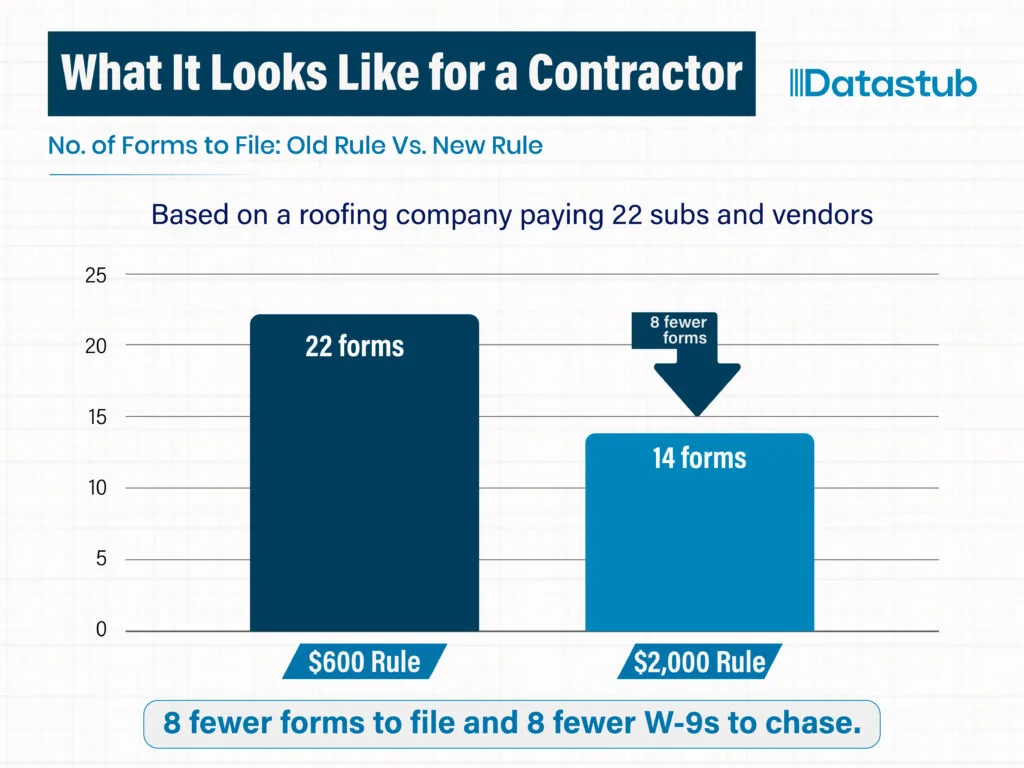
Take a roofing company that paid 22 subs and vendors at least $600 each in 2026 — install crews, a gutter sub, a dumpster company, and a truck mechanic. Under the old $600 limit, all 22 would get a 1099. Under the new $2,000 limit, only the 14 paid $2,000 or more do. That’s 8 fewer forms to file and 8 fewer W-9s to chase.
Small, one-off jobs are where you’ll feel it most. Say an HVAC company paid a duct-cleaning company $1,800 for a few service calls. Under the old rule, that meant a 1099. For 2026, no federal 1099 is needed.
Three habits keep your count accurate:
- Add up by person, not by job. Four $600 jobs from the same sub add up to $2,400. That sub gets a 1099, even though no single payment reached $2,000.
- Watch for one sub under two names. If a sub billed you as “Mike’s Drywall” in the spring and “Mike Torres” in the fall, that’s one person. Add the payments together.
- Look at the full year. A helper you paid $1,200 by June could pass $2,000 by December. Your December 31 total is what counts.
What Didn’t Change
The dollar limit moved. Most of the other 1099 rules stayed the same and these are the ones contractors ask about most.
Your sub still owes tax on every dollar. No 1099 doesn’t mean no tax. A sub you paid $1,500 still reports that $1,500 as income. The new rule cuts paperwork, not taxes.
A 1099 doesn’t make someone a sub. What matters is how much control you have over the work, not which form you send. A helper who works only for you, on your schedule, with your tools, may count as an employee in the IRS’s eyes. Our guide to W-2 vs. 1099 worker classification explains what the IRS looks for.
Most corporations still don’t get a 1099. If a sub’s business is a corporation (C corp or S corp), you usually don’t send them one. LLCs can go either way, depending on how they’re taxed, and the W-9 tells you which.
One exception: lawyers get a 1099 for their fees, even if their firm is a corporation.
Labor and materials on one invoice are reported together. If a sub’s bill includes the materials they used on your job — like an electrician’s panel upgrade with the wire and breakers included — report the full amount. Materials you buy yourself from a supplier don’t count at all. Shingles, copper pipe, a pallet of insulation: no 1099. Tracking subs and materials separately in your books also gives you true job costing, so you can see what each job really made.
How you paid still matters. Leave out anything you paid by credit card, debit card, or a business payment app like PayPal or Venmo. The card company or app reports those payments on its own form, the 1099-K. Payments by check, bank transfer, cash, or Zelle are yours to report. Zelle moves money straight from bank to bank, so it doesn’t send a 1099-K.
Rent goes in a different form. Rent paid for your business — a storage yard, a shop, a piece of equipment will report on Form 1099-MISC if the amount paid reaches $2,000 for the year.
Say an electrical contractor rents a yard for $650 a month. That’s $7,800 a year, so the landlord gets a 1099-MISC.
Ten or more forms means you file online. If your W-2s and 1099s add up to 10 or more, all of them have to be filed electronically. A company with 6 employees and 5 subs who need 1099s has 11 forms, so paper is out. The IRS has a free online system called IRIS, and most payroll and accounting software can file for you.
The W-9 Habit Still Pays Off
A W-9 is the form where a sub gives you their legal name and tax ID number. If a sub won’t give you one or the IRS tells you their number is wrong — you’re required to hold back 24% of what you pay them and send it to the IRS. This is called backup withholding.
Here’s an example. A plumbing company hires a new sub for a commercial job and pays them $5,000 in one draw. The sub never returned a W-9. So the company keeps $1,200 (24% of $5,000), pays the sub $3,800, and sends the $1,200 to the IRS. That $1,200 also shows up on the sub’s 1099-NEC.
The fix is simple: get the W-9 before you pay the first invoice. In March, you can’t know which subs will reach $2,000 by December. With a W-9 on file from day one, you never have to hold back anyone’s pay — and you’re not chasing forms in January from subs who’ve moved on.
How to make it a habit:
- Ask every new sub, helper, or vendor for a W-9 before their first payment — even for small jobs.
- Save each W-9 with that vendor in QuickBooks or whatever software you use.
- When you add a vendor, mark whether they need a 1099, so your year-end report pulls the right list.
- Ask for a new W-9 when a sub changes their business name or sets up a new company.
Your State May Still Use $600
The $2,000 limit is a federal rule. Each state makes its own.
Not every state follows the federal number. California moved to $2,000 for 2026, but Mississippi and Wisconsin still use $600 in some cases. And in a few states, if you took state tax out of a sub’s pay, you have to send them a 1099 no matter how much you paid.
Texas and Florida are simpler: they have no state income tax, so there’s usually no state 1099 to file.
This matters most if you work in more than one state. A sub you paid $1,500 may not need a federal 1099 — but a state with a lower limit could still want one.
The fix takes a few minutes. Before January, look up each state where you paid subs — the table below links to every state’s tax page. If your software files 1099s for you, make sure it uses each state’s limit, not just the federal one.
State-by-State 1099 Rules for 2026
Here’s where every state stands as of November 2, 2026, based on each state’s own tax website.
- Twelve states follow the federal $2,000 limit, nine set their own dollar limit,
- fifteen only want a 1099 when you take state tax out of the payment, and
- twelve don’t collect these 1099s at all.
So far, only California and Oregon have clearly confirmed $2,000 for 2026, so check your state’s page before you file.
|
State |
What the state requires for 2026 |
Good to know |
| Alabama | Own limit: $1,500 | Due March 15 (January 31 if Alabama tax was withheld) |
| Alaska | No state filing | No state income tax |
| Arizona | Only if state tax was withheld | Any amount when Arizona tax is withheld |
| Arkansas | Own limit: $2,500 | Any amount if Arkansas tax was withheld |
| California | Follows federal: $2,000 | Confirmed for 2026 |
| Colorado | Only if state tax was withheld | |
| District of Columbia | Own limit: $600 | Page still shows 2025 rules |
| Florida | No state filing | No state income tax |
| Georgia | Only if state tax was withheld | Due February 1, 2027 |
| Idaho | Follows federal | Ties filing to the federal form |
| Illinois | No state filing | Only 1099-K is required |
| Indiana | Only if state or county tax was withheld | |
| Iowa | Only if state tax was withheld | |
| Kansas | Follows federal | |
| Kentucky | Only if state tax was withheld | |
| Louisiana | Follows federal (1099-NEC) | 1099-MISC only for some nonresident rents and royalties |
| Maine | Follows federal | Required even with no Maine tax withheld |
| Maryland | Only if state tax was withheld | |
| Massachusetts | Follows federal | Must file directly with the state |
| Michigan | Follows federal | 1099-NEC must be filed directly with the state |
| Minnesota | Only if state tax was withheld | |
| Mississippi | Own limit: $600 | Not yet updated for 2026 |
| Missouri | Own limit: $1,200 | Only when a federal 1099 is also required |
| Montana | Own limit: $600 | 2026 guide still lists $600 |
| Nebraska | Only if state tax was withheld | |
| Nevada | No state filing | No state income tax |
| New Hampshire | No state filing | No state income tax on wages |
| New Jersey | Own limit: $1,000 | Any amount if New Jersey tax was withheld |
| New Mexico | No state filing | Except some oil and gas payments |
| New York | No state filing | |
| North Carolina | Only if state tax was withheld | |
| North Dakota | Follows federal | |
| Ohio | Only if state tax was withheld | |
| Oklahoma | Own limit: $750 | Due February 28 |
| Oregon | Follows federal: $2,000 | Confirmed for 2026 |
| Pennsylvania | Follows federal | |
| Rhode Island | Follows federal | Changed by a 2026 state law |
| South Carolina | Only if state tax was withheld | |
| South Dakota | No state filing | No state income tax |
| Tennessee | No state filing | No state income tax on wages |
| Texas | No state filing | No state income tax |
| Utah | Only if state tax was withheld | |
| Vermont | Follows federal (limited) | When Vermont tax was withheld, or for nonresidents who worked in Vermont |
| Virginia | Only if state tax was withheld | |
| Washington | No state filing | No state income tax |
| West Virginia | Only if state tax was withheld | |
| Wisconsin | Own limit: $600 | Not yet updated for 2026 |
| Wyoming | No state filing | No state income tax |
“Follows federal” means the state wants a copy of any 1099 you have to file with the IRS, so the $2,000 limit carries over. States update these pages through January, so check yours again before you file.
When You’re the One Getting Paid
Most trades are on both sides of this. You pay subs, and you also get paid by general contractors, property managers, and commercial customers.
On that side, expect fewer 1099s in January 2027. A property manager who paid your plumbing company $1,700 for a few service calls won’t send one. A GC who paid you $40,000 by check for a job still will.
Fewer forms don’t change what you owe. Every dollar you earn is still income, with or without a 1099. Your tax return should match your books — not the 1099s that show up in the mail.
That makes your own records more important. When your books match every deposit to a customer and a job, you know your real income without waiting on anyone else’s paperwork. You can also set aside the right amount for quarterly estimated taxes. Good records keep your cash steady through slow months too — see our Cash Flow Guide for Contractors.
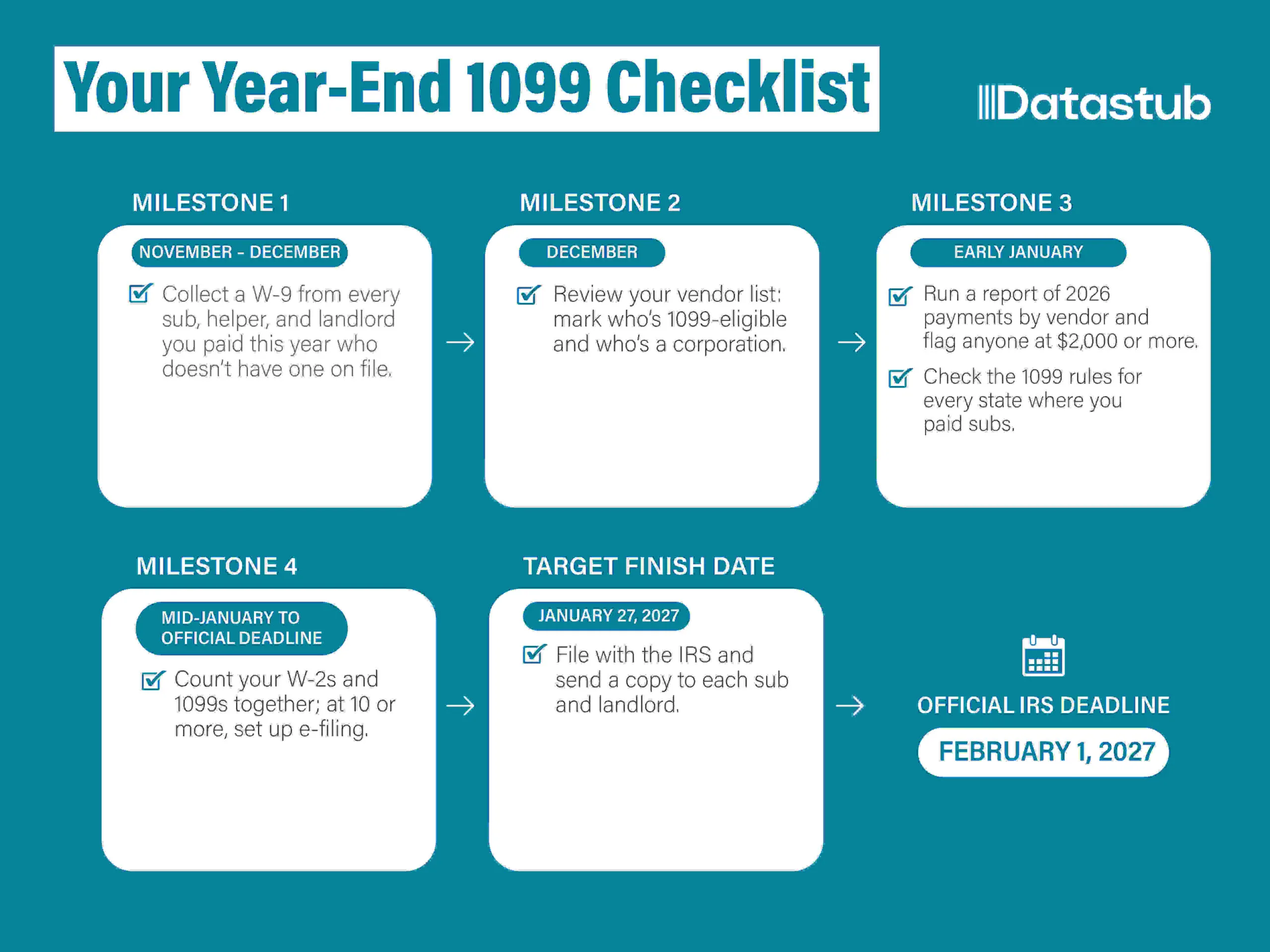
Your Year-End 1099 Checklist
Work through this list between now and the deadline, and January becomes a short job instead of a scramble.
|
When |
What to do |
|
November–December |
Collect a W-9 from every sub, helper, and landlord you paid this year who doesn’t have one on file |
|
December |
Review your vendor list: mark who’s 1099-eligible and who’s a corporation |
|
Early January |
Run a report of 2026 payments by vendor and flag anyone at $2,000 or more |
|
Early January |
Take card and payment-app payments out of those totals |
|
Early January |
Check the 1099 rules for every state where you paid subs |
|
Mid-January |
Count your W-2s and 1099s together; at 10 or more, set up e-filing |
|
By January 27, 2027 |
File with the IRS and send a copy to each sub and landlord. The deadline is February 1, but finishing a few days early leaves time to fix any mistakes. |
How Datastub Helps
At Datastub, 1099s are part of the bookkeeping all year — not a January fire drill. For contractor clients, that means:
- W-9s collected and saved with each vendor as subs come on board
- Vendors flagged for 1099 eligibility in QuickBooks from day one
- Payments sorted by method, so card and app payments stay off your forms
- Federal and state thresholds checked for every state you work in
- 1099s e-filed and sent to your subs before the deadline
It all runs on clean, current books — the same books that give you true job costing and a clear view of your cash. See how our bookkeeping and payroll services work, how we support contractors, and how we clean up QuickBooks files that have fallen behind.
Frequently Asked Questions
I paid a sub $1,500 in 2026. Do they still owe tax on it?
Yes. The $2,000 limit only decides whether you send a form. Your sub still reports every dollar they earned, 1099 or not.
Do I still need a W-9 from subs I’ll pay under $2,000?
Yes, collect one anyway. You can’t always tell who will reach $2,000 by the end of the year. Without a W-9 on file, you’d have to hold back 24% of their pay once they do. The W-9 also tells you if the sub is a corporation, which decides whether they need a 1099 at all.
Does an LLC sub get a 1099?
It depends on how the LLC is taxed. A one-owner LLC, or one taxed as a partnership, usually gets a 1099. An LLC taxed as an S corp or C corp usually doesn’t. The W-9 has a box that tells you which it is.
I paid for a sub through Zelle or Venmo. Who reports it?
It depends on the app. Venmo, PayPal, and other business payment apps report those payments on Form 1099-K, so leave them off your 1099. Zelle is a bank-to-bank transfer and doesn’t send a 1099-K, so Zelle payments count toward your $2,000 total, just like a check.
Does my state follow the new $2,000 rule?
Not always. California and Oregon moved to $2,000, but states like Mississippi and Wisconsin still use $600. Find your state in the state-by-state table above — each row links to that state’s tax page.
When are 2026 1099s due?
February 1, 2027. That’s the deadline for both the IRS copy and your sub’s copy. If you have 10 or more W-2s and 1099s combined, you’ll need to file them online.
Fewer Forms, Same Good Habits
The new $2,000 limit is real relief. For 2026, most contractors will send fewer 1099s and chase fewer W-9s.
The habits that make 1099s easy haven’t changed. Get the W-9 first. Add up payments by sub, not by job. Know how you paid. Check your state’s rules. Stick with those four, and January takes care of itself.
Want a second set of eyes before filing season? Book a free 15-minute diagnostic with Datastub. We’ll go through your vendor list and tell you straight which subs need a 1099 — and which don’t.