

Most owners think the paperwork decides it. Sign a contractor agreement. Send a 1099 in January. Done. The IRS does not read the agreement. It looks at how the work actually happens – who sets the schedule, who owns the tools, who carries the risk. Paperwork describes the arrangement. Behavior defines it. That gap is where classification goes wrong. And it almost never goes wrong on purpose. It goes wrong because a helper became a crew member over eighteen months, and nobody stopped to re-file the paperwork. Here is the test the IRS actually applies, what a wrong call costs, and how to fix one cheaply.
The One Question That Decides Every Worker Classification
Strip away the forms and one question remains. Does this person run their own business, or do they work in yours? A contractor takes real risk. A bad job can cost them money. They set their own hours, bring their own tools, and serve other customers. Method is their call, not yours. An employee trades that risk for stability. You direct the work, supply what they need, and pay them whether the job made money or not. Everything else is detail hanging off that one question. “Owners ask me which form to send. That is the wrong end of it. Decide what the relationship actually is, then the form is obvious.” – Chetan Raval, Payroll Operations, Datastub
The Two Workers Almost Every Growing Company Gets Wrong
Picture a contractor bookkeeping client — a roofing company with six crew on W-2 and four people paid on 1099. Two of those four are genuine subs. They bid jobs, bring their own crews, carry their own insurance, and work for three other roofers. The other two are a different story. The field worker. Started as overflow help two summers ago. Now he works only for this company, drives a company truck, follows a schedule the owner sets each Monday, and wears a company shirt. Paid $68,000 last year. The office admin. Answers the phone and handles scheduling, 30 hours a week, on the company’s hours and the company’s computer. Paid $42,000. Nobody here is cutting corners. The setup got inherited and never revisited. That is the most common version of this problem, and it is very fixable.
W-2 vs 1099: The Twelve Differences That Actually Decide It
Here is the practical split. Read down the column that matches your situation.
| W-2 employee | 1099 contractor | |
|---|---|---|
| Who sets the hours |
You do |
They do |
| Who decides the method |
You do |
They do |
| Tools and equipment |
You supply them |
They supply their own |
| Training |
You train them |
They already know how |
| Other clients |
Usually just you |
Several, by design |
| Can they lose money? |
No |
Yes, on a bad bid |
| Can they send a substitute? |
No |
Usually yes |
| Who covers expenses |
You reimburse |
They absorb them |
| How pay works |
Hourly or salary, on a cycle |
Per project or per milestone |
| Length of arrangement |
Open-ended |
Job-based, with an end |
| Your tax duties |
Withhold, match FICA, pay FUTA |
Send a 1099 if over the threshold |
| Their protections |
Overtime, unemployment, workers comp |
None from you |
Read the field worker against that table. He lands on the left in ten rows out of twelve. The office admin lands on the left in every row.
The IRS Worker Classification Test: Three Questions That Settle Status
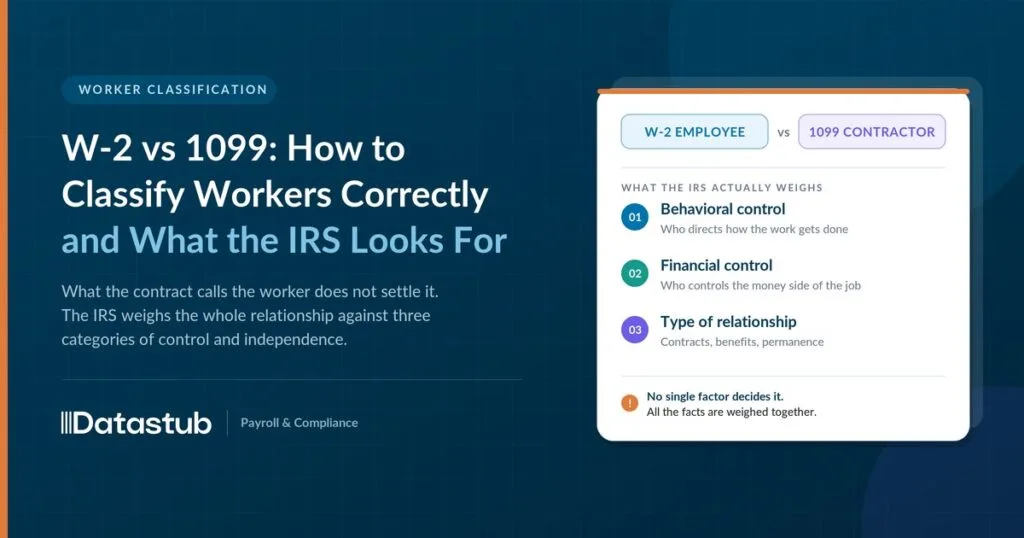
The IRS groups its analysis into three buckets, together known as the common law test. No single answer settles it, and there is no scoring sheet. You weigh the whole picture.
Behavioral Control: Who Decides How the Work Gets Done?
This one carries the most weight. Do you tell them when to show up, what order to do things in, and which methods to use? Do you train them your way? Directing the result is normal for both. Directing the method points to employment. Telling the field worker which job to be at, and when, is method control.
Financial Control: Who Carries the Risk of Losing Money?
Look at who carries financial risk. Has the worker invested in their own equipment? Do they have unreimbursed expenses? Can they take a loss? Also look at how they get paid, and whether they market themselves to other customers. The field worker uses the company’s truck and the company’s tools. He has no way to lose money on a bad week. That is not a business – that is a wage.
Type of Relationship: Is This Work Core to What You Sell?
Is there a written contract, and does real life match it? Do you provide benefits? Is the arrangement open-ended? And is the work a core part of what your company sells? That last one matters more than owners expect. Roofing labor at a roofing company is the product. A bookkeeper, a web designer, a lawyer – those sit outside the core.
Seven Things Owners Believe About 1099s That Do Not Hold Up
These come up in almost every conversation. “He signed a contractor agreement.” A contract describes intent. The IRS looks at conduct. Where the two disagree, conduct wins every time. “He asked to be 1099.” Classification is not a preference either side can elect. A worker cannot consent their way out of employee status. “He has an LLC and an EIN.” Helpful, not decisive. An entity is one piece of evidence about running a real business. It does not outweigh daily control. “He works for other people too.” This genuinely helps. But it does not fix a relationship that is employment in every other respect. “He’s only part-time.” Hours have nothing to do with it. A six-hour-a-week employee is still an employee. “He invoices us.” An invoice is a document, not a relationship. Employees can be made to invoice. It changes nothing. “Everyone in our trade does it this way.” Industry practice is not nothing – it can support Section 530 relief, covered further down. But it is a defense you argue, not a rule you rely on.
What Misclassification Really Costs: $25,245 Saved, $35,244 Owed Back
Now the numbers. This is the part worth reading twice. Those two workers cost a combined $110,000 a year. Run as 1099, the payroll tax on them is zero. Run as W-2, the company pays 7.65% in FICA, or $8,415 a year, plus unemployment insurance and workers comp. So the 1099 setup appears to save $8,415 annually. Over three years, roughly $25,245. Now the correction. When a misclassification was not intentional and the Forms 1099 were filed, the IRS applies reduced rates under section 3509. That works out to 10.68% of the wages paid, for compensation under the Social Security wage base. On $110,000, that is $11,748 a year. Across the same three years, $35,244 – before interest, before failure-to-deposit penalties, and before any state assessment.
| Three years as 1099 | Three years as W-2 | |
|---|---|---|
| Payroll tax paid at the time |
$0 |
$25,245 |
| Cost to correct at 10.68% |
$35,244 |
$0 |
|
Total |
$35,244 |
$25,245 |
The saving was never real. It was a deferral, and it came back about 40% larger. One more rate worth knowing. If the required Forms 1099 were never filed, section 3509 doubles the withholding pieces. The effective rate climbs to roughly 13.71%. Filing the 1099 is what keeps the cheaper rate available – which is a strong argument for filing them even while you are unsure about classification.
Three Ways to Fix a Misclassification, From Cheapest to Most Expensive
Three routes exist. They are not equally priced, and the difference comes down to who moves first.
Section 530 Relief: How to Remove the Liability Entirely
Section 530 can eliminate the liability entirely. You need all three of these:
- Reporting consistency. You filed all required federal returns treating the worker as a non-employee. Forms 1099 included.
- Substantive consistency. That worker – and everyone in a substantially similar role – stayed a contractor from 1977 onward.
- Reasonable basis. You relied on a prior audit that raised no issue, on a long-standing practice in your industry, on published legal precedent, or on some other genuinely reasonable ground.
The IRS refreshed its guidance here in January 2025 through Revenue Ruling 2025-3 and Revenue Procedure 2025-10. The clarification worth knowing: Section 530 covers classification disputes only. Arguments about whether a particular payment counts as wages fall outside it. Notice that reporting consistency requires the 1099s. Skip those and you lose the strongest defense available.
The VCSP: Reclassify Going Forward for 10% of One Year’s Liability
If Section 530 does not fit, the VCSP lets you reclassify going forward at a heavy discount. You pay 10% of the section 3509(a) liability for the most recent year only. Prior years are not assessed. On that same $110,000, the payment is 10% of $11,748 – about $1,175. Against $35,244 on audit, the gap speaks for itself. Eligibility is narrow, though:
- You currently treat the workers as contractors
- You have treated them consistently that way for three years
- You filed the required Forms 1099 for those years
- You are not under employment tax audit by the IRS, the Department of Labor, or a state agency
You apply on Form 8952, at least 120 days before the date you want the reclassification to start. That last condition is the one that expires. Once an audit letter arrives, this door closes.
Waiting for the IRS: Why Doing Nothing Costs the Most
The third route is doing nothing. It costs the most, and the trigger usually comes from outside your control. A worker files Form SS-8, asking the IRS to rule on their status. Or they file Form 8919 to claim the payroll taxes you never withheld. State unemployment claims start audits just as often. Where the IRS finds intentional disregard, the reduced rates disappear entirely. Full liability applies, and responsible individuals can be assessed personally under the trust fund recovery rules.
Two Worker Classification Rules Changed in 2026, and Both Affect You
Both land in 2026, and most articles on this topic have not caught up.
The 1099 Reporting Threshold Rose From $600 to $2,000 for 2026
The old $600 reporting threshold had stood since 1954. Under the One Big Beautiful Bill Act, it rises to $2,000 for tax year 2026, with inflation adjustments starting in 2027. Useful, but read it carefully. The threshold changes when you must send a form. It changes nothing about who is an employee. A worker you pay $1,800 can still be an employee, and you would still owe withholding on every dollar. There is a quiet trap here too. Reporting consistency under Section 530 depends on filing required 1099s. Fewer forms required means fewer chances to build that record. Where classification is genuinely uncertain, filing anyway remains the safer habit.
The DOL Proposed a New Independent Contractor Test in February 2026
On February 26, 2026 the DOL issued a proposed rule covering contractor status under the Fair Labor Standards Act, the FMLA, and the migrant worker statute. The comment period closed on April 28, 2026. It is not final. The proposal would rescind the 2024 rule, which the Department has already stopped applying in investigations. In its place comes a streamlined economic reality test. Two core factors lead it: control, and opportunity for profit or loss. Three more support them – skill required, permanence, and whether the work forms part of integrated production. Now the part that catches people. The DOL test and the IRS test are separate. DOL governs wage and hour law: overtime, minimum wage, back pay. IRS governs employment taxes. A worker can be a contractor for one and an employee for the other, and your state may reach a third answer. Watch this one, but do not restructure around a proposed rule. Nothing is final yet.
Your State May Apply the Stricter ABC Test
Federal is the floor, not the ceiling. State rules stack on top of the federal ones, which is why multi-state payroll compliance matters here too. Several states apply the ABC test, which starts by presuming the worker is an employee. You rebut it by proving all three:
- A – the worker is free from your control in fact and under contract
- B – the work sits outside your usual course of business
- C – the worker is customarily engaged in an independently established trade of the same type
Prong B is the hard one for trades. Roofing labor at a roofing company sits squarely inside the usual course of business, so the field worker above fails prong B before anyone reaches prong A. California, Massachusetts, and New Jersey are the strictest, and other states apply versions of it for unemployment insurance. If you operate across state lines, run each worker against each state where they work. Good payroll outsourcing builds that check into onboarding rather than leaving it to memory.
How to Correct a Worker Classification You Think Is Wrong
Work down this path. Stop where it applies to you. Are you under audit right now, or have you had contact from the IRS, DOL, or a state agency? Yes – stop and get representation before you reclassify anything. Voluntary programs are already closed to you. No – keep going. Did you file Forms 1099 for this worker, every year, consistently? Yes – Section 530 is live. Start there. No – Section 530 is likely out. Go to the VCSP question. Can you show a reasonable basis: a clean prior audit, an established industry practice, or legal precedent? Yes – document it now, while the people who remember are still around. Dates, names, written evidence. No – go to the VCSP question. Have you treated the worker as a contractor consistently for three years, with 1099s filed? Yes – you likely qualify for the VCSP. File Form 8952 at least 120 days before your intended start date. No – reclassify going forward and correct the current year. Then talk to someone about the exposure behind you. Do you have others in substantially similar roles? Almost certainly yes. Fix them together. Substantive consistency means one reclassification affects how every similar role gets judged.
What a Clean Worker Classification Process Looks Like
A clean setup is not complicated. It runs like this. Every worker gets classified before the first payment, not after the first tax season. The decision gets written down – one page per worker, with the reasoning and the date. That page is what turns an assumption into a defensible position. Contractor files hold real evidence: a scope of work with an end date, a certificate of insurance, their EIN, and an invoice that looks like it came from a business. Not a timesheet with a different heading. Roles get re-reviewed every year, because misclassifying an employee as a contractor usually happens by drift rather than by decision, because relationships drift. That field worker was a genuine sub in his first summer. Nothing was re-examined when he stopped being one. Getting the payroll setup right from the start keeps this simple. Payroll and books stay connected, so a contractor who starts looking like staff shows up in the numbers early. Clean outsourced bookkeeping makes that visible in a monthly review rather than in an audit. And the 1099s go out, even in the years you are still deciding. They cost almost nothing and they protect the cheapest exit you have. Handled this way, classification stops being a yearly worry. It becomes one short step in onboarding – which is exactly where it belongs. Not sure how your crew is classified? Send us your worker list and how each one gets paid. We will go through them one by one, tell you which ones are solid, which ones need a second look, and what it takes to fix anything early. Free consultation, no pressure. Disclaimer: This article is for general information only and does not constitute legal or tax advice. Worker classification depends on the full facts of each relationship, and federal, state, and Department of Labor tests can reach different answers. Please consult a qualified professional about your situation before reclassifying anyone.