

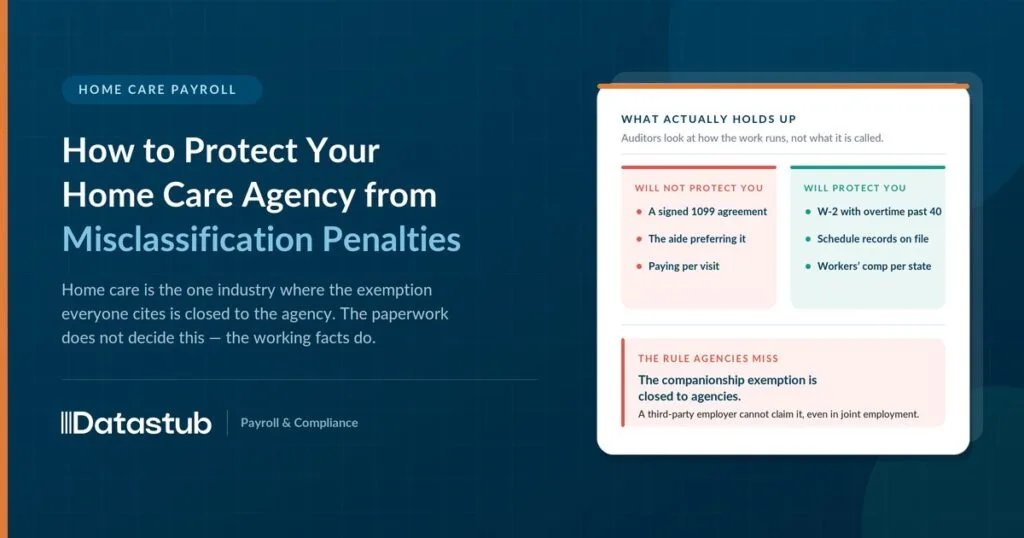
A common belief among home care agencies is that a caregiver who sets her own availability, works part-time, and isn’t required to take every shift offered can be paid as a 1099 contractor. That belief is usually wrong, and it’s the exact reasoning that shows up in nearly every DOL enforcement case against a home care agency.
Setting availability isn’t the test. The test is who controls how the work gets done once a shift is accepted, and in home care, the agency almost always does: assigning the client, setting the care plan, requiring specific documentation, and reserving the right to reassign or discipline. That’s behavioral control, and it’s the single factor that turns a “contractor” back into an employee under IRS, DOL, and most state tests.
Protecting your agency starts with understanding that test, then moves through what it actually costs when the test isn’t met, how to check your own payroll against it, and how to fix what you find. Here’s that path in order.
Step 1: Understand What Actually Triggers Reclassification
We cover the broader rules on classifying any worker as a contractor separately; caregiving is simply one of the industries where that test is hardest to pass. The IRS, the Department of Labor, and most states each run their own version of the same underlying question: who controls how the work gets done. In home care, the agency almost always does, which is why caregiver misclassification cases are so common and so hard to defend.
A written agreement calling someone a contractor doesn’t change the answer. Enforcement agencies look at how the relationship actually operates, the paperwork is evidence of intent, not proof of status.
Step 2: Know What Each Enforcement Track Can Do to You
A single misclassified caregiver creates exposure on three separate tracks at once that don’t cancel each other out. An agency can settle with the IRS and still face a DOL claim for the same worker, and a state agency can pursue its own case under a stricter test than either federal one uses.
| Track | What’s owed | Lookback period |
|---|---|---|
| IRS | Back payroll taxes, the employer’s unpaid FICA share, penalties and interest | Generally 3 years, longer if no return was filed |
| DOL (FLSA) | Back wages plus liquidated damages equal to the back wages owed | 2 years for non-willful violations, 3 years for willful |
| State | Back wages under the state’s own test, often the ABC test, which is stricter than the federal standard | Varies by state, commonly 2-4 years |
The IRS Track: Back Taxes and Penalties
The IRS classifies workers using a common law test built around behavioral control, financial control, and the type of relationship between the agency and the caregiver. When it reclassifies a 1099 caregiver as an employee, the agency owes its share of unpaid FICA taxes on every dollar paid to that worker, plus penalties and interest for the tax that was never withheld or matched.
The DOL Track: Back Wages and Liquidated Damages
Under the Fair Labor Standards Act, a caregiver misclassified as a contractor typically wasn’t paid overtime for hours over 40 in a week, since contractor pay is usually a flat rate regardless of hours. The DOL can recover that unpaid overtime as back wages, and by law, the Secretary of Labor or the worker can also recover an equal amount again as liquidated damages. That doubles the wage exposure before a single penalty is added.
The State Track: Often the Strictest Test
Many states apply an ABC test, which presumes a worker is an employee unless the business proves all three of: the worker is free from the company’s control, the work falls outside the company’s usual business, and the worker independently operates in that trade. For a home care agency, caregiving is the business, which makes the second prong nearly impossible to satisfy. State enforcement has been especially active in home care specifically, and some state cases have resulted in multimillion-dollar findings against single agencies.
Step 3: Know What One Caregiver Actually Costs
This is the kind of gap we regularly find reviewing payroll for home care agencies specifically: take a caregiver averaging 45 hours a week, paid a flat $18 an hour with no overtime premium, misclassified as a 1099 contractor for one year.
| Cost component |
Amount |
|---|---|
| Unpaid overtime (5 hours/week over 40, at 1.5x, for 52 weeks) |
$7,020 |
| FLSA liquidated damages (equal to the unpaid overtime) |
$7,020 |
| Employer’s unpaid FICA share (7.65% of $42,120 in gross wages) |
$3,222 |
| Subtotal, one caregiver, one year |
$17,262 |
That figure doesn’t include state-level back wages if the state’s ABC test applies, separate IRS penalties and interest, legal fees, or the DOL’s own civil penalty for repeat or willful violations, which is adjusted annually and assessed per violation. Most home care agencies don’t misclassify one caregiver, they misclassify a whole category of workers under the same pay structure, which means this number multiplies by every caregiver paid the same way. That multiplication is exactly why protecting the agency means checking the whole roster, not one worker at a time.
Step 4: Run This Self-Audit on Your Own Payroll
Most of this audit can be run using data you already have in Gusto or your existing payroll platform, since the hours and pay history are already tracked.
- Pull every worker currently paid on a 1099. List them by role, not by name, to see the pattern rather than individual cases.
- For each role, write down who sets the schedule. If the agency assigns clients, shifts, or care plans, that’s behavioral control, and it points toward employee status.
- Check whether the worker can decline an assignment without consequence. A true contractor relationship allows this. Most caregiving arrangements don’t.
- Calculate the overtime gap for anyone averaging over 40 hours a week. This is the number that drives most of the DOL exposure, and it’s calculable from timesheets or scheduling software today.
- Confirm the applicable state test, since a worker who might pass a federal analysis can still fail a state ABC test, and the stricter test controls.
- Decide on a remediation path before a worker files a claim or a state task force flags the agency, since voluntary reclassification carries meaningfully less exposure than a finding after the fact.
Step 5: Fix What the Audit Finds, the Right Way
Where the audit surfaces a real gap, the fix is a proper reclassification and payroll setup, not a quiet switch that leaves the same control structure in place with a different pay code. That includes registering correctly in every state the caregiver worked in, setting up withholding going forward, and deciding how to handle the exposure already created for prior periods before a state task force or a caregiver’s attorney decides it for you.
Voluntary correction, done before a claim is filed, is consistently treated better by every one of the three enforcement tracks than a finding made after the fact. That difference alone is often the strongest argument for running the audit now rather than waiting.
A Rule Change Worth Watching, But Not Waiting On
Two federal actions are moving at the same time, in opposite directions. A February 2026 proposed rule would reinstate a narrower, two-factor test emphasizing control and profit-or-loss opportunity, which could make contractor classification somewhat easier to defend federally. Separately, a proposed rule would restore minimum wage and overtime exemptions for companion care and live-in workers employed through third-party agencies, which would narrow DOL exposure specifically for that worker category if finalized. Neither is final, and state-level enforcement isn’t waiting on either one. Protecting the agency means classifying workers against the rules in effect today, not a rule that might take effect later.
Frequently Asked Questions
Does a signed independent contractor agreement protect the agency?
No, on its own it doesn’t. Enforcement agencies look at how the working relationship actually functions, who controls the schedule, the care plan, and the assignment, not what the paperwork calls the worker. A contractor agreement paired with employee-level control is evidence against the agency, not protection for it.
Should we wait for the pending rule changes before reclassifying anyone?
No. Both the proposed federal rules discussed above are still pending, and state enforcement, which is often stricter than either federal test, isn’t waiting on them. Classify against the rules that apply today, and revisit the analysis if either rule is finalized.
What’s the fastest way to know if we have exposure right now?
Run Step 4 above against your current 1099 roster. Most agencies can complete the schedule-control and overtime-gap questions using data already in their payroll platform, without outside help, in under an afternoon.
Does misclassification insurance cover these penalties?
Most general liability and EPLI policies exclude wage and hour violations, including misclassification back wages and liquidated damages, or cover them only with a specific endorsement most agencies don’t carry. Confirm your actual policy language rather than assuming coverage exists.
Protect Your Agency Before Your Next Payroll Run
The decision isn’t whether misclassification risk exists, the case history above settles that. The decision is whether to find it through your own audit or through a state task force, a DOL investigation, or a caregiver’s attorney, because the cost difference between those two paths is significant. If your self-audit surfaces a caregiver, or a whole category of caregivers, paid in a way that doesn’t hold up against the tests above, the fix is a reclassification done correctly, not a quiet switch that leaves the same control structure in place with a different pay code. We help home care agencies work through that reclassification, the payroll setup that follows it, and the multi-state registration it usually requires. Reach out before your next payroll run, not after a notice arrives.
This article is for general informational purposes and does not replace advice from your CPA, employment attorney, or tax advisor. Worker classification tests vary by federal agency and by state, and penalties depend on your specific facts and history. Consult a qualified professional about your situation. For the DOL’s own guidance on back wage recovery and liquidated damages under the FLSA, see DOL: Back Pay.