

The right partner for outsourcing at a certified public accountant (CPA) firm adds production capacity without adding review risk. Three things decide that. The provider’s work has to arrive review-ready. Your client data has to stay protected. And the pricing model has to match how your workload moves through the year.
This guide to CPA outsourcing shows how to test each one before you sign. First, it covers what to hand off. Next, it compares engagement models and builds a cost model from your own numbers. Then it turns to review quality, compliance, and the checks worth running on any provider. Finally, it lays out a pilot that proves the fit. Datastub is an outsourcing provider, so weigh our view accordingly. The criteria here apply to any firm on your shortlist, including us.
Decide What to Outsource Before You Choose a Provider
Scope comes first, and bookkeeping services for CPAs are usually the easiest scope to hand off. Most problems trace back to a fuzzy scope, not to a provider’s skill. Start with work that is repeatable and well documented. Monthly bank matching, transaction coding, payroll entries, and trial balances all fit.
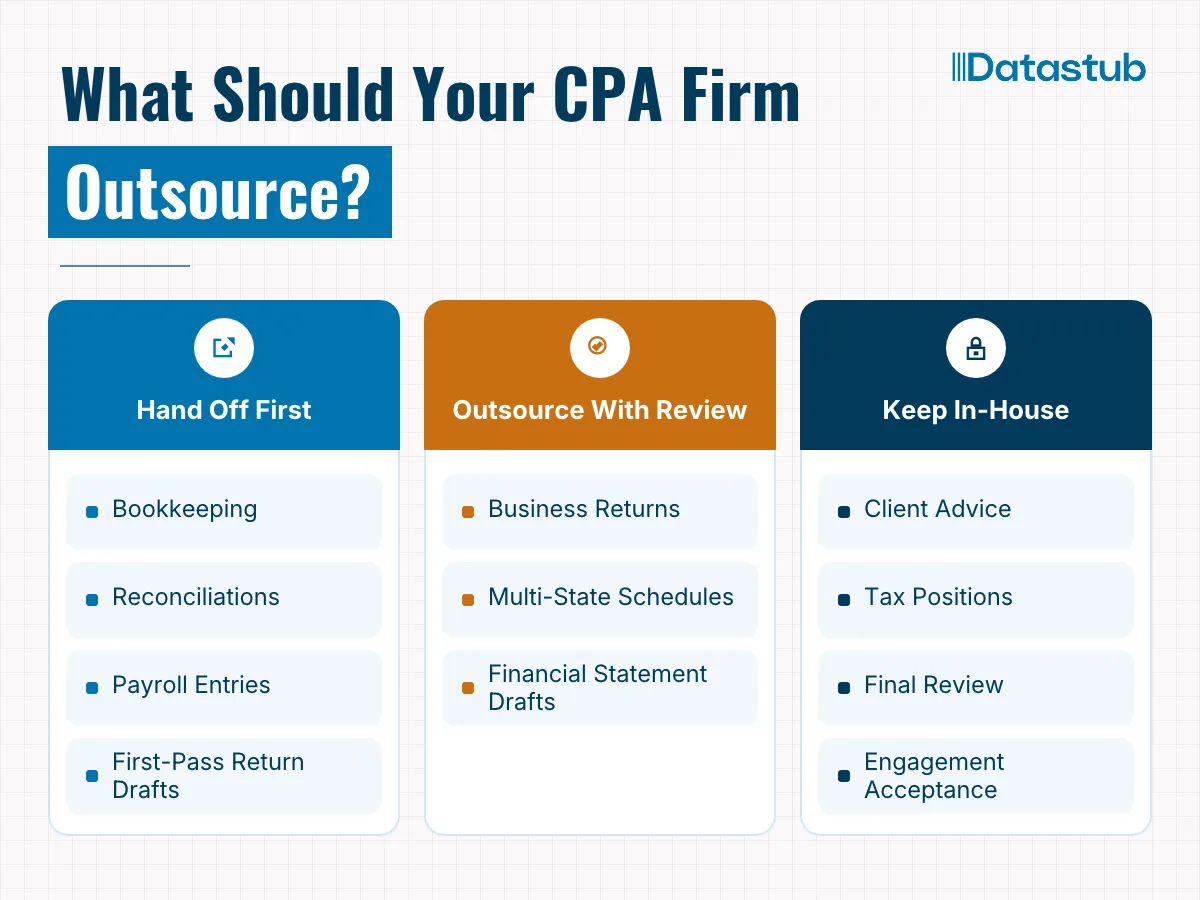
A simple sort helps. Divide your work into three groups:
- Hand off first: repeatable work with clear inputs and outputs. Examples are bookkeeping, reconciliations, payroll entries, and first-pass return drafts.
- Hand off with a review layer: work that needs judgment but follows your templates. Examples are business returns, multi-state schedules, and financial statement drafts.
- Keep in-house: client advice, tax positions, engagement acceptance, and final review. Anything that needs a substantive determination under your signature stays here too.
That last group matters for compliance, too. As the rules later in this guide show, substantive tax determinations change which consent steps apply.
Clear scope is the foundation of CPA outsourcing, so write it down by task and client type. “Bookkeeping” is too broad. Try this instead: monthly bank and credit card reconciliations for clients on QuickBooks Online, delivered by the fifth business day. A provider can price that scope, and a reviewer can test it.
Engagement Models Compared: Per-FTE, Per-Project, Per-Hour
Pricing structure shapes your results as much as price does. Most providers offer three models, and Datastub’s outsourced accounting services for CPA firms are no exception. You can pay per full-time equivalent (FTE), per project, or per hour. Each rewards a different workload pattern.
| Model | How you pay | Best fit |
|---|---|---|
| Per-FTE | Fixed monthly fee for a dedicated person or small team | Steady year-round volume; firms that want the same names on their files |
| Per-project | Fixed fee per return, engagement, or cleanup | Defined, repeatable work such as business returns or catch-up bookkeeping |
| Per-hour | Billed for hours worked | Variable or short-term work, overflow, and pilots |
In CPA outsourcing, the pricing model should follow your workload curve. Chart your last three years of billable hours by month. A flat line favors per-FTE. Sharp seasonal peaks favor per-hour or per-project pricing, sometimes paired with a small dedicated team for the base load.
Build a Cost Model From Your Own Numbers
An hourly rate alone is a weak comparison. What matters more is how many of a person’s paid hours you can fill with work, which is called utilization. The figures below are illustrative assumptions, not market prices. Replace them with your own.
- Calculate the actual cost of hiring an employee
Let’s assume you hire an accountant with an annual salary of $75,000.
However, the actual cost to your business is higher than just the salary. You also need to consider payroll taxes, employee benefits, software, training, and other related expenses.
Assuming these additional expenses are 30% of the salary:
- Annual salary: $75,000
- Additional expenses (30%): $22,500
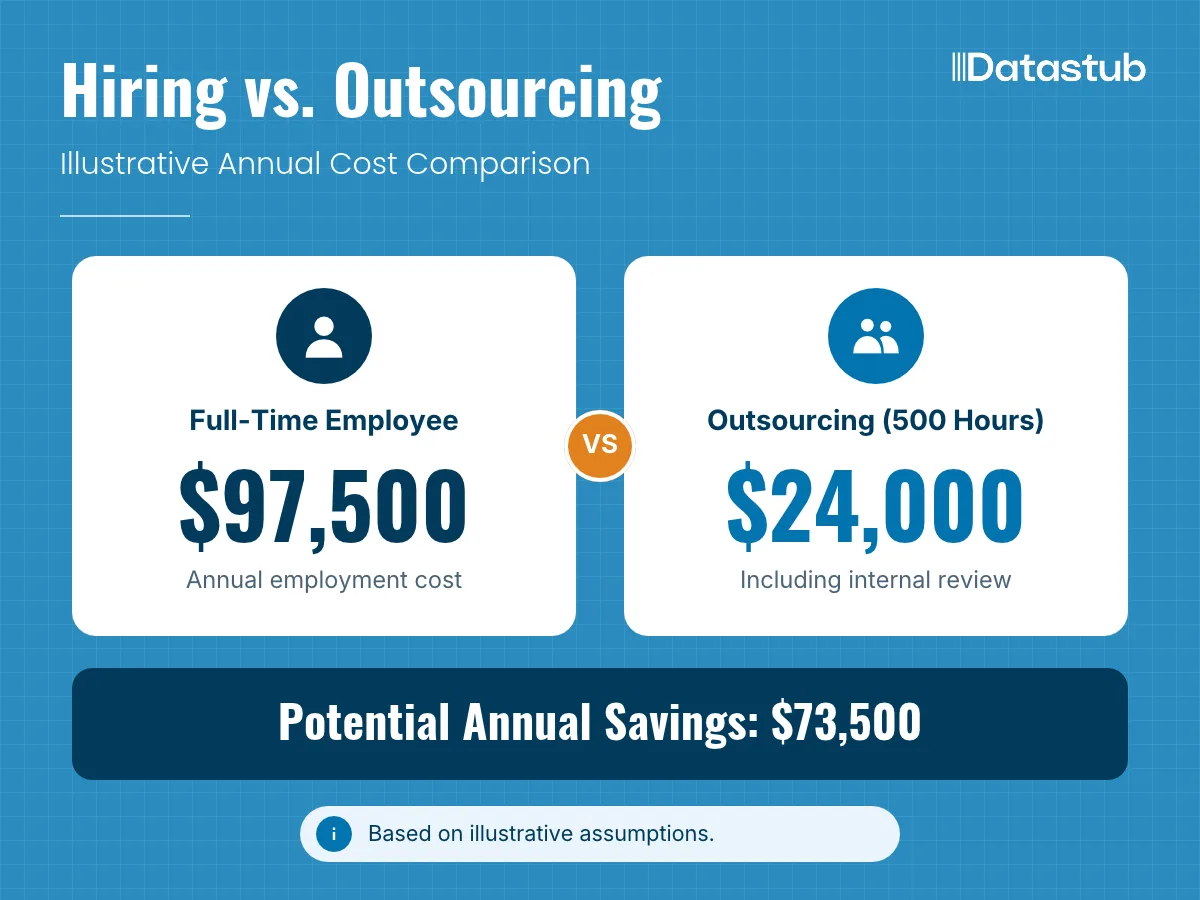
- Total annual employment cost: $97,500
An employee may be available for approximately 1,500 productive working hours annually after accounting for holidays, leave, training, and other non-billable time.
Therefore:
$97,500 ÷ 1,500 hours = $65 per productive hour.
This means your actual cost of employing this person is $65 for every productive hour of work.
- Calculate the actual cost of outsourcing
Now, suppose an outsourcing company offers accounting services at $30 per hour.
At first glance, outsourcing appears much cheaper than hiring an employee. However, there is another cost to consider: the time your internal team spends reviewing the outsourced work.
For example:
- Outsourcing provider’s fee: $30 per hour.
- Your internal reviewer spends 9 minutes checking each hour of outsourced work.
- The reviewer’s loaded cost is $120 per hour.
Since 9 minutes is 0.15 hours, the review cost is:
$120 × 0.15 = $18.
Therefore, your actual outsourcing cost becomes:
| Cost component | Amount |
| Outsourcing provider’s fee | $30 |
| Internal review cost | $18 |
| Total outsourcing cost per hour | $48 |
So, although the provider charges only $30 per hour, your actual cost is $48 per hour after including internal review time.
- What happens when your workload is seasonal?
This is where the comparison becomes interesting.
Suppose your accounting firm needs additional support for only 500 hours during the busy tax season (January to April).
Even if you hire an employee for this requirement, you will still need to pay the full annual employment cost of $97,500, even if the employee is not fully occupied during the remaining months.
Let’s compare the two options:
Employee Hiring vs. Outsourcing: Cost Comparison
| Particulars | Full-time employee | Outsourcing |
| Annual employment cost / Vendor rate | $97,500 | $30/hour |
| Productive hours available / Work required | 1,500 hours | 500 hours |
| Internal review cost | Included in employment cost | $18/hour |
| Total annual cost | $97,500 | $24,000 |
| Effective cost per working hour | $65 | $48 |
What does this mean financially?
Hiring an employee
| Hiring an employee | Outsourcing 500 hours | Potential annual savings |
| $97,500 | $24,000 | $73,500 |
Based on the illustrative assumptions above.
- So, should you hire or outsource?
The decision is not just about comparing hourly rates. It is about how consistently you have work available throughout the year.
- Hiring makes sense when you have a steady workload throughout the year and can keep your employee productively occupied.
- Outsourcing makes sense when your workload increases during specific months, when you need additional capacity during tax season, or when hiring a full-time employee would leave you paying for unused capacity.
- A combination of both can work best. Maintain an in-house team for regular accounting operations and use outsourcing partners to manage seasonal workloads and additional client requirements.
One important point: Always include your internal team’s review time when calculating outsourcing costs. This gives you a more realistic comparison and helps you make better hiring and outsourcing decisions.
Protect Review Quality as Capacity Grows
Review quality is the real test of CPA outsourcing, and a clear definition of “done” is where it starts. A structured month-end close checklist shows the idea. Every step has an owner and an output before anything reaches a reviewer. The same discipline applies to every deliverable you outsource.
Where the Bottleneck Moves
CPA Practice Advisor made a useful point in September 2026. Production volume can rise quickly in busy season, but experienced reviewers cannot multiply with it. Poor planning just moves the queue to the review desk.
A Review Hand-Off Standard
Agree on a hand-off standard in writing before the first delivery. The standard should include:
- Every workpaper should include the preparer’s name, date, and standard review tick marks or firm’s legend.
- Match all financial records with the relevant returns and statements.
- Maintain a list of pending questions and get clarification from the client or reviewer instead of making assumptions.
- Highlight major changes and unusual differences compared to the previous year.
- Attach or link supporting documents for easy reference rather than relying on memory.
Review all work thoroughly at the beginning. Once the provider’s quality is established, review selected work samples. Return to full reviews whenever a new type of tax return or a new preparer is introduced.
Confidentiality and Compliance Questions for CPA Outsourcing
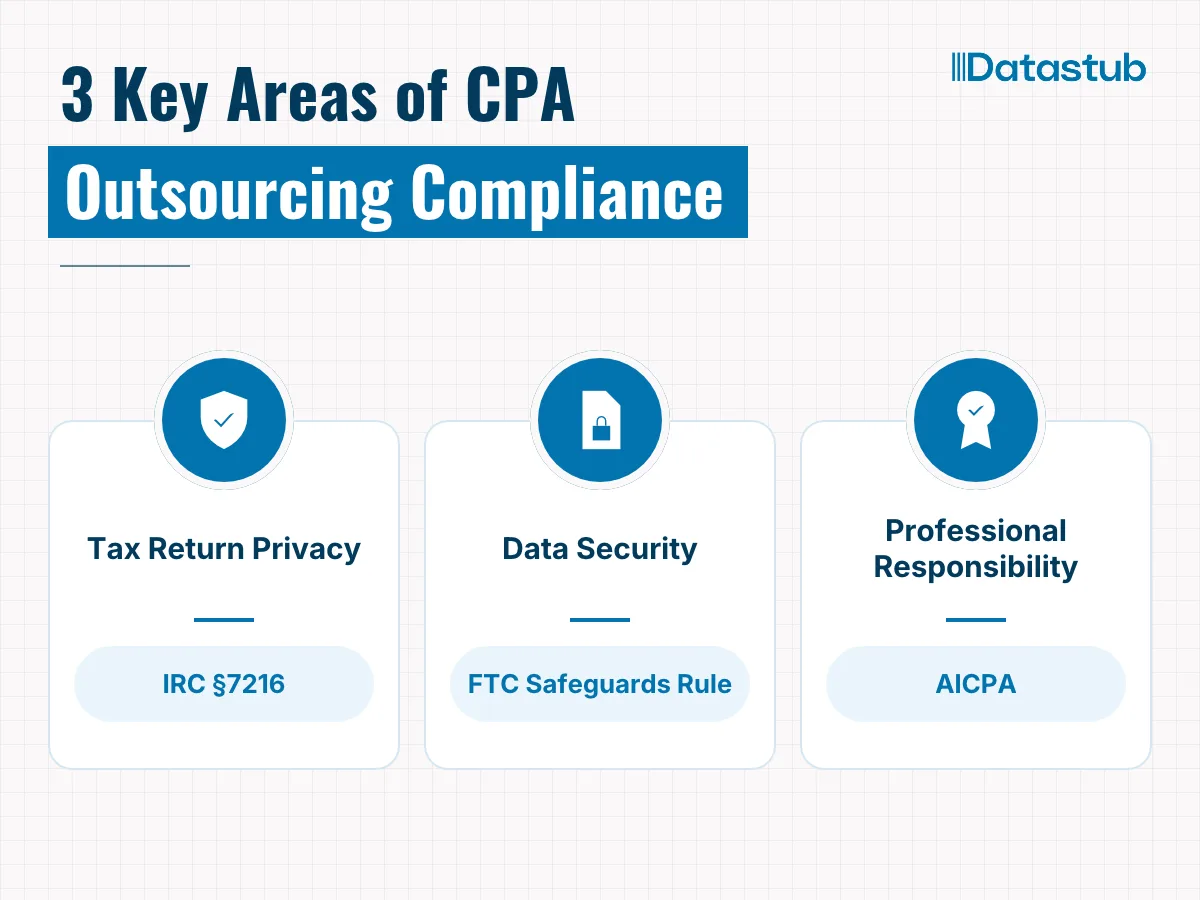
Three sets of rules shape CPA outsourcing. First comes the federal tax return privacy law. Next is the Federal Trade Commission (FTC) Safeguards Rule. Last is the Code of Professional Conduct from the American Institute of CPAs (AICPA). This section summarizes what each one asks of your firm. Treat it as a map for your conversation with counsel, not as legal advice.
IRC Section 7216 and Offshore Delivery
Section 7216 of the Internal Revenue Code (IRC) limits how tax return preparers disclose and use tax return information. Section 6713 adds a related civil penalty. The Internal Revenue Service (IRS) explains both in its Section 7216 FAQ. The table lists the penalty figures and the regulations that matter most for outsourcing.
| Rule | What it says | Source |
|---|---|---|
| IRC §7216 | Criminal misdemeanor for knowingly or recklessly disclosing or using return information beyond preparing the return. Fine of up to $1,000, up to one year in prison, or both for each violation. | IRS FAQ |
| IRC §6713 | Civil penalty of $250 per disclosure, capped at $10,000 per person per calendar year. Unlike IRC §7216, IRC §6713 imposes penalties for unauthorized disclosure without requiring the disclosure to be knowing or reckless. | IRS FAQ |
| Treas. Reg. §301.7216-2(d)(1) | Disclosure to another preparer located in the United States is allowed without consent to assist with return preparation, if the work is not a substantive determination. | Regulation |
| Treas. Reg. §301.7216-3(a)(3)(i)(D) | Taxpayer consent is required before any disclosure to a preparer outside the United States. | Regulation |
| Treas. Reg. §301.7216-3(b)(4) and Rev. Proc. 2013-14 | For Form 1040 filers, the SSN is masked before return information goes abroad. Narrow exception where both preparers maintain an adequate data protection safeguard. | Regulation, Rev. Proc. |
| Consent mechanics | Signed and dated by the taxpayer, obtained before disclosure. Lasts one year if no duration is stated. | Regulation |
Three practical points follow. First, a U.S.-based provider assisting with return preparation generally needs no consent, as long as it makes no substantive determinations. The regulation defines those as analysis, interpretation, or application of the law. Second, sending return information to a provider outside the United States needs the taxpayer’s signed consent before the disclosure. Third, the preparer masks the Social Security number (SSN) before 1040 information goes abroad. The exception applies only when both preparers maintain an adequate data protection safeguard.
Bookkeeping records that are not used for return preparation can sit outside Section 7216, as the Journal of Accountancy notes. The AICPA and FTC rules below still apply to them. Ask every provider where its team sits. Ask whether SSNs are masked before files reach it. Also ask who drafts the consent language, which must follow Rev. Proc. 2013-14.
FTC Safeguards Rule and Your Written Security Plan (TBR -Nimeshbhai)
The FTC Safeguards Rule (16 CFR Part 314) treats tax and accounting professionals as financial institutions. As a result, your firm needs a Written Information Security Plan (WISP). The rule also covers vendors. Your firm must choose capable providers. It must also require safeguards by contract and oversee how providers handle client data. Your CPA outsourcing partner therefore belongs in your WISP.
IRS Publication 5708 offers a WISP template. IRS Publication 4557 lists the security measures every tax professional should have in place. The Journal of Accountancy also explains how the rule affects CPA firms.
AICPA Confidentiality and Supervision
The AICPA Code of Professional Conduct addresses outsourcing under ET Sections 1.150.040, 1.300.040, and 1.700.040.
CPA firms remain responsible for the quality of outsourced work and should verify that service providers have the necessary qualifications and technical skills. Clients should be informed, preferably in writing, when third-party providers may be used. Confidentiality must also be protected through appropriate contractual safeguards or client consent, as applicable. For tax return information, additional consent requirements under IRC §7216 may apply, particularly when information is shared with offshore providers.Outsourcing does not transfer the CPA firm’s professional responsibility for the work. Proper due diligence, data protection, supervision, and review remain essential. The Journal of Accountancy walks through outsourcing and professional liability in detail.
Security Evidence to Request (TBR -Nimeshbhai)
Ask for evidence rather than assurances when you vet CPA outsourcing providers. A solid provider can show you:
- A signed agreement with confidentiality, breach notice, subcontractor, and data return or destruction terms.
- The access model: work performed inside your systems, or files transferred out.
- Multi-factor authentication (MFA) on every account that touches client data, and activity logs you can review.
- Named team members, screening practices, and a plan for staff changes.
- Insurance certificates, such as professional liability (errors and omissions) and cyber coverage.
- Independent proof of controls, or a clear substitute. If a provider cites an audit report such as System and Organization Controls (SOC) 2, ask for the report and check its scope and dates. Not every provider has one. If yours doesn’t, ask for its written security policy, a completed copy of your security questionnaire, and a live walkthrough of how its staff reach your client files.
- Where the work happens matters as much as the provider’s certifications. When staff work inside your systems, your own controls and logs cover the data, and less of it leaves your environment.
White-Label, Staff Augmentation, and Service Bureau Models
CPA outsourcing comes in three main delivery models. The labels often overlap. The clearer way to compare them is by who directs the work and who talks to your clients. Services such as accounting outsourcing can run under any of them.
| Model | Who directs the work | Who talks to your clients | Good fit when |
|---|---|---|---|
| White label | The provider runs the service to your standards | Provider staff, under your firm’s name | You want to offer a service, such as bookkeeping, without building an in-house team for it |
| Dedicated Staff (Per FTE) | You / Your managers assign and review the work daily | You / Your team only | You have reviewers and steady work, and need more hands |
| Project-based Handoff (Per Project) | The provider works from your files and checklist, and you review and sign | You / Your team only | You need extra help for a fixed job, such as busy-season returns or a bookkeeping cleanup |
Dedicated staff usually maps to per-FTE pricing, and project-based handoff to per-project pricing. White-label work is often priced per client or per service each month.
A Provider Due-Diligence Checklist for CPA Firms
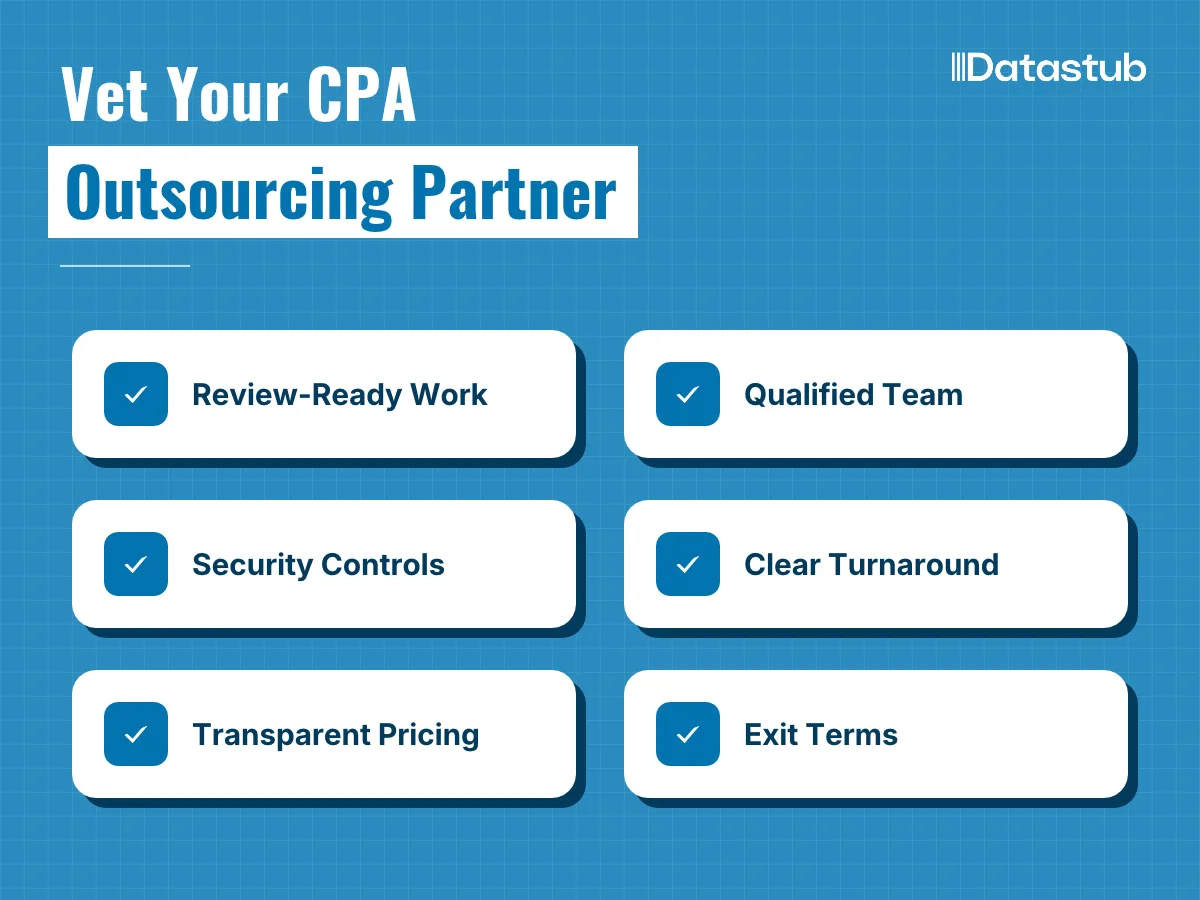
Providers publish plenty of “best of” lists, and many rank themselves first. When you shortlist CPA outsourcing providers, criteria will serve you better than rankings. The firms that scale without hiring more staff tend to test these points before signing:
- Names and tenure of the people who will touch your files, and the replacement plan if one leaves.
- A sample of review-ready work in your own software, not a generic demo.
- Written deliverable definitions for each return type and task.
- Turnaround commitments for normal weeks and for peak weeks.
- The access model, MFA, and logging, as described in the compliance section.
- What the price includes: onboarding, review rounds, rework, and minimum terms.
- Exit terms: notice period, file return, and data destruction.
- Two references from firms of similar size and software.
- How the provider logs errors found in review and feeds them back to the preparer.
Some signals deserve a closer look before you proceed:
- Savings claims with no stated method or assumptions.
- No sample work product before signing.
- Vague answers on SSN handling, access, or subcontractors.
- Pricing that leaves out rework, onboarding, or minimum terms.
- Long lock-in periods with no exit or data-return clause.
Run a Pilot Before You Commit to Any Contract
In CPA outsourcing, a pilot turns every claim above into evidence, and business tax return preparation files make a good test. Mix files at different stages of readiness, and add one messy bookkeeping file. Then follow six steps:
- Pick a scope that reflects real work. Use one or two clients, with a mix of clean and messy files.
- Write acceptance criteria before kickoff. Define the tie-outs, turnaround, and open-item quality you expect.
- Complete consent, confidentiality, and access setup first. No client data moves until they are in place.
- Review every pilot delivery in full, and record the reviewer minutes each one takes.
- Score the results: error rate by category, reviewer minutes per delivered hour, turnaround, and communication.
- Decide to expand, adjust the scope, or stop. A pilot that ends in a clear no is still a good outcome.
What a Good CPA Outsourcing Partnership Looks Like
After three to six months, a healthy CPA outsourcing partnership shows a few consistent signs:
- Reviewer minutes per delivered hour fall in the first three months, then hold steady.
- The same named people work on your files.
- Open items arrive as specific questions, not blank cells.
- You see open hours before busy season starts, not during it.
- Your partners spend more time on advice and client conversations than on first-pass production.
That is the standard to hold any provider to. If you want to test it with Datastub, we offer a complimentary one-week pilot for CPA firm partners. Book a short call and tell us which work you want to hand off first. We will tell you straight whether we are the right fit.
Crunch. Strategize. Deliver.
This article is for general information only and is not tax, legal, or professional advice. Consult a qualified professional about your firm’s situation.