

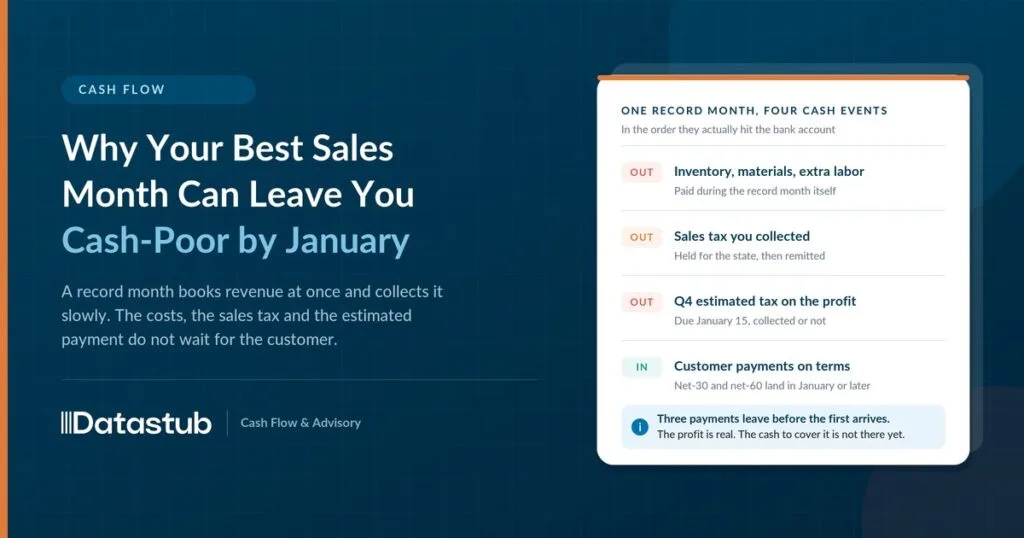
A business closes out its best Q4 ever. Revenue is up, the holiday push worked, and the bank balance looks strong through the last week of December. Then January arrives, and the same business is short on cash, scrambling to cover a tax payment, a new state filing notice, or a supplier invoice it didn’t expect to feel tight for.
This isn’t bad luck, and it isn’t really a cash flow mystery either. It’s three specific, predictable mechanisms that all land in the same six-week window right after your best quarter, and almost nothing written about post-holiday cash flow names them directly.
The Three Mechanisms That Drain Q4 Cash
Three specific things hit in the same six-week window right after a strong quarter: a tax payment sized off the sales you just made, a state filing obligation you didn’t know you’d triggered, and cash your processor is holding back that you already booked as revenue. Each one is manageable on its own. Arriving together, they’re what actually causes the January crunch, not a generic failure to “plan ahead.”
The Tax Bill Sized Off Your Best Quarter
If your business pays estimated taxes, the fourth-quarter payment covering September through December is due January 15. That payment is calculated from the income you actually earned in that period, which means a record Q4 in sales produces a record Q4 estimated tax bill, arriving exactly when your cash is already tied up in restocked inventory and holiday payroll.
Here’s the mechanism in numbers. A business that earned $80,000 in taxable profit for a typical quarter and owed roughly $20,000 in estimated tax might see Q4 profit of $180,000 after a strong holiday season, and the estimated payment scales with it, closer to $45,000. The percentage didn’t change. The dollar amount the business has to produce in cash, three weeks after the season ends, more than doubled.
Businesses that track this well set aside a fixed percentage of each week’s Q4 revenue into a separate account as the sales happen, rather than calculating the number in January when the cash is already spent. Our tax team sees this exact gap every January: strong sales, tight cash, and a payment that was predictable months in advance.
The Nexus Threshold You Crossed Without Noticing
Most states require sales tax registration once a seller crosses an economic nexus threshold, commonly $100,000 in sales or 200 transactions in that state within a 12-month period. A normal month might sit comfortably under that line in every state. A holiday spike can push a seller over the threshold in two or three new states in a single quarter, and most sellers don’t find out until a notice arrives, sometimes with penalties calculated back to the date the threshold was actually crossed.
This is a separate problem from knowing what’s taxable once you’re registered, which varies by product and by state. (We cover what’s actually taxable in each state separately, since nexus tells you where you owe tax and taxability tells you what you owe it on, and sellers regularly confuse the two.) The practical fix is checking nexus status against actual Q4 sales data in the first two weeks of January, not waiting for a notice to force the question.
The Payout Holds Nobody Budgets For
Payment processors, including Shopify Payments, Stripe, and PayPal, commonly place rolling reserves or temporary payout holds on accounts after a period of unusually high volume or an elevated return rate, both of which are normal outcomes of a strong holiday season. That reserve is cash the business technically earned and already reported as revenue, but can’t actually spend until the hold releases, often weeks later.
Chargebacks compound this on a longer delay. A customer can dispute a holiday purchase 60 to 90 days after the sale, which means chargebacks from November and December sales frequently land as cash outflows in late January or February, against revenue that’s already been spent on inventory, payroll, or that tax payment. Building a rolling reserve estimate into a cash forecast, rather than treating processor cash as fully spendable the moment it shows up, is what prevents this from becoming a surprise.
What to Do Before Your Next Q4
- Set aside a fixed percentage of Q4 revenue weekly, not a lump-sum estimate calculated after the season ends.
- Check your nexus status against actual Q4 sales data in the first two weeks of January, in every state you sold into, not just the ones you’re already registered in.
- Build processor reserves and a chargeback allowance into your cash forecast, treating a portion of processor cash as delayed rather than immediately spendable.
- Separate your tax reserve account from your operating account, so a strong sales week doesn’t quietly get spent before the quarter’s tax liability is calculated.
- Run a rolling 13-week cash forecast through January, not just a monthly view, since all three mechanisms above hit on different timelines within the same six weeks.
A Q4 cash flow forecast built before the season starts, not after it ends, is what turns these three mechanisms from a surprise into a known, budgeted cost of a strong quarter.
Common Questions About Q4 Cash Flow
Why does my tax bill jump after a strong quarter?
Your estimated tax payment is calculated as a percentage of the income you actually earned in that quarter. The percentage stays the same, but a record Q4 in sales produces a record Q4 profit, so the dollar amount owed on January 15 scales with it. It isn’t a rate increase, it’s the same rate applied to a much bigger number.
How do I know if I’ve crossed a new nexus threshold?
Pull your actual sales-by-state data for the quarter and compare it against each state’s economic nexus threshold, commonly $100,000 in sales or 200 transactions in a 12-month period, though the exact figures vary by state. Do this in the first two weeks of January rather than waiting for a state to send a notice, since penalties are often calculated back to the date the threshold was actually crossed.
Can I get processor holds released faster?
Sometimes. Processors typically release rolling reserves on a set schedule tied to your account’s return rate and dispute history stabilizing, rather than on request. The more reliable fix is forecasting around the hold rather than trying to accelerate its release, since the release timeline is usually the processor’s call, not yours.
The Mistakes That Turn a Good Quarter Into a Cash Crisis
Calculating the Q4 tax payment in January instead of setting it aside weekly. By the time the number is calculated, the cash is usually already spent on restocking.
Assuming nexus status hasn’t changed since last quarter. A holiday spike is exactly the kind of event that pushes a seller over a new state’s threshold.
Treating processor cash as fully spendable the moment it appears in the dashboard. Reserves and holds are common after high-volume periods, and budgeting around the full number invites a shortfall.
Forecasting cash flow by month instead of by week during Q4 and January. Monthly views smooth over exactly the kind of timing gaps that cause the crunch.
Waiting for a nexus notice or a tax deadline to force the question. Every one of these mechanisms is checkable in advance, from your own sales data.
None of these are complicated to fix individually. What makes them dangerous is that they hit in the same narrow window, right when a business has the least cash on hand relative to what it just earned. If your best quarter keeps turning into your tightest month, reach out and we’ll build the Q4 forecast before the season starts, not after.
This article is for general informational purposes and does not replace advice from your CPA or tax advisor. Estimated tax requirements, nexus thresholds, and processor policies vary by business, state, and platform. Consult a qualified professional about your specific situation. For the IRS’s own guidance on estimated tax payment deadlines, see IRS estimated taxes FAQ.