

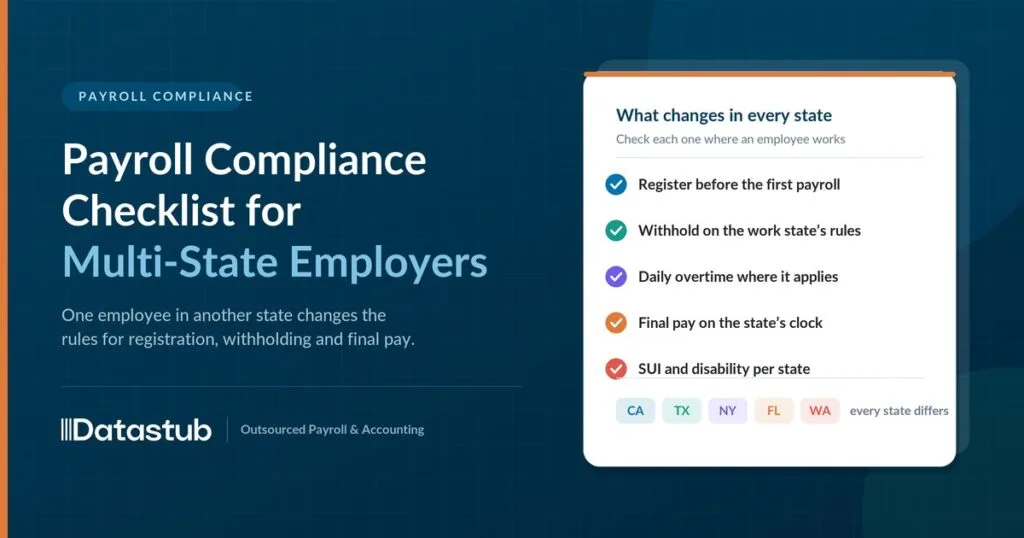
You hired your first out-of-state employee. Maybe a remote worker in California. Maybe you opened a second location in Colorado. Either way, something changed the moment that person started working. Now you run payroll in two places under two sets of rules. Different tax rates. New minimum wages. Separate leave laws. Filing deadlines that do not line up. The good news is that this is a setup problem, not a permanent burden. Once each state is registered, configured, and sitting on your filing calendar, the monthly work barely changes. The fourteen items below are that setup.
Why Multi-State Payroll Follows the Employee, Not Your Office
A solid multi-state payroll setup starts with one rule. Payroll follows where the employee works, not where your business is registered. Say your company is registered in Texas and an employee sits in California. That employee follows California rules. Texas rules apply only to the people working in Texas. One business can therefore owe registration, withholding, and reporting in four states at once. Here is what changes from state to state:
- Income tax withholding. California has some of the highest rates in the country. Texas and Florida have no state income tax at all.
- Minimum wage. California sits at $16.90 an hour, Colorado at $15.16, Florida at $14.00, and Texas at the federal $7.25. Same job, very different floor. The DOL publishes a current state minimum wage table.
- Overtime rules. California pays overtime after 8 hours in a single day. Colorado pays after 12 hours in a day, or 12 consecutive hours. Most states track weekly hours only.
- Paid leave programs. California funds State Disability Insurance and Paid Family Leave through employee deductions. Colorado runs a similar program called FAMLI. Texas and Florida have neither.
- Final paycheck timing. California requires payment the same day you let someone go. Texas allows six calendar days.
- Workers’ compensation. Nearly every state requires coverage. Texas is the exception, where private employers may opt out.
So the employee’s work location sets the rules. Not where your business is headquartered. Not where you mailed the offer letter. Where they sit and do the work.
How Texas, California, Colorado, and Florida Compare Side by Side
| Area | Texas | California | Colorado | Florida |
|---|---|---|---|---|
| State income tax |
None |
Yes, progressive |
Yes, flat 4.4% |
None |
| Minimum wage |
$7.25 (federal) |
$16.90 |
$15.16 |
$14.00* |
| Daily overtime |
None |
After 8 hours | After 12 hours |
None |
| Paid family leave |
None |
Yes (SDI/PFL) | Yes (FAMLI) |
None |
| Final pay, discharged |
Within 6 days |
Immediately | Immediately |
Next payday |
| Final pay, resigned |
Next payday |
Last day with 72hr notice | Next payday |
Next payday |
| SUI wage base |
$9,000 |
$7,000 | $30,600 |
$7,000 |
| Exempt salary floor |
Federal |
$70,304 | $57,784 |
Federal |
|
Workers’ comp |
Optional (private) | Required | Required |
Required |
*Florida rises to $15.00 on September 30, 2026. Figures verified August 2026. Confirm current rates before each payroll run, since most states adjust on January 1.
Which State Gets the Unemployment Tax When Work Crosses Lines
Once you know how payroll taxes work at the federal level, a harder question follows. Which single state gets the unemployment tax when someone works in more than one? Unemployment insurance goes to one state only. Every state applies the same four-part test, in order, until one answer fits.
- Where is the work localized? If the employee performs all or nearly all of their work in one state, that state takes it. This settles most cases on its own.
- Where is their base of operations? When the work is genuinely split, look to the home office, the truck yard, or wherever the day starts and ends.
- Where does direction and control come from? If the first two tests fail, the state where the supervising happens takes it.
- Where does the employee live? Only when the first three give no clear answer.
Take a field tech who moved to Florida and now does every job there. That work is localized in Florida, even though dispatch still runs out of Texas. The unemployment tax follows the worker.
The 14-Point Multi-State Payroll Compliance Checklist
Take payroll system setup one state at a time. That is the fastest way through. Check each item off once per state. Then put a date on the calendar to look at it again, because these rules change every year.
1. Register in Every State Where You Have Employees
- Register with the state revenue office for income tax withholding
- Sign up with the state unemployment office too. It is usually a separate agency
- Add the state labor department wherever that state asks for it
- Get your state employer ID numbers before you run the first paycheck
What an eight-month registration gap costs to unwind. Picture two California employees earning $55,000 each, paid on a Texas configuration for eight months. California received no registration, no payment, and no filing. Each one should have had State Disability Insurance held back at 1.3% on roughly $36,700 of wages. That is about $477 apiece. Add the unemployment tax owed to California on the first $7,000 of each worker’s wages. Then add eight months of California income tax. The fix runs through the California Employment Development Department. Register first, then file the back returns, then pay what should have gone to California. Franchise Tax Board registration is a separate corporate tax question, not a payroll step.
2. Confirm and Document Where Each Employee Actually Works
- Confirm each remote employee’s main work state, and get it in writing
- Update payroll the same week an employee moves for good
- Look at the tax impact before you approve a move to a new state
- Decide up front how you will handle staff who cross state lines in one week
3. Collect the Right Tax Forms for Each State
- Federal Form W-4 for every employee
- A state withholding certificate wherever the state uses its own, such as California DE 4 or Colorado DR 0004
- Local tax forms where a city or county levies its own income tax
- Keep every form on file, and swap it out when an employee hands you a new one
4. Set Up the Correct Withholding for Each State
- State income tax at the correct state rate
- Local income tax where a city or county requires it
- Disability insurance in states that run a program: California, New Jersey, New York, and Rhode Island
- Paid family leave deductions where required, such as California PFL and Colorado FAMLI
- Payroll software that works out multi-state rates and updates them on its own
What California actually costs on a $55,000 salary. An employee earning $55,000 a year in California should see three separate items on the stub. State income tax comes first, withheld on California’s progressive rate tables. State Disability Insurance follows, at 1.3% of gross wages, the rate California’s EDD sets each year. That is $715 a year, and the employee pays all of it. There is no wage ceiling either, not since 2024. So the deduction runs on every dollar all year instead of stopping partway through. Paid Family Leave sits inside that same 1.3% contribution rather than on a separate line. When these are missing, the employee comes up short for the state and owes a balance at tax time.
5. Pay the Highest Applicable Minimum Wage: Federal, State, or Local
- Check the current minimum wage in the employee’s state, then check their city or county too
- Pay whichever rate is highest: federal, state, or local
- Update pay rates before January 1, when most states adjust
- Watch cities that set their own floor above the state rate, including Denver, Los Angeles, and Seattle
6. Apply Each State’s Overtime Rules, Not Just the Federal One
- Federal: overtime after 40 hours in a workweek
- California: overtime after 8 hours in a day or 40 hours in a week, plus double time after 12 hours in a day
- Colorado: overtime after 12 hours in a day, 12 consecutive hours, or 40 hours in a week, whichever produces the most pay
- Nevada: daily overtime after 8 hours for employees earning under one and a half times minimum wage
- Set up timekeeping state by state, not one rule for all
The four-day week that quietly carries eight overtime hours. A California employee works 10-hour days, four days a week. That is 40 hours, the same as a standard week. Under federal and Texas rules, there is no overtime at all. Under California rules, hours 9 and 10 are overtime every single day. That comes to 8 overtime hours a week, every week. At $30 an hour, the half-time premium is $15 per overtime hour. The gap runs $120 a week, or roughly $6,240 a year for one employee. When California overtime runs on a Texas setup, the fix is back wages plus interest.
7. Set Up Every Paid Leave Program That State Requires
- Find out which states require paid sick leave, paid family leave, or short-term disability
- Check who pays for each one: you, the employee, or both
- Set up the deductions and your share inside payroll
- Track what builds up and what rolls over, state by state
- Update handbooks and offer letters to match each state’s leave
8. Report New Hires to Each State on Time
- Report within 20 days of the hire date in most states, per the federal new hire reporting rules. Several want it sooner
- Send it to the state where the employee works, not where your business is based
- New hire reports feed child support orders and fraud checks, which is why states chase them
- Build the report into your onboarding steps so nobody has to remember it
9. Maintain Workers’ Compensation Coverage in Every State
- Check that coverage is active in every state where your people work
- Tell your carrier when someone moves, or when you enter a new state
- Check the job class codes. The wrong one hits both your coverage and your premium
- Keep certificates of coverage on hand for each state
- Texas is the only state where private employers can turn coverage down
- Those employers must then file notice with the Division of Workers’ Compensation, and post notice to staff
10. Know Each State’s Final Paycheck Deadline Before You Need It
- California: immediately on the day you let someone go. An employee who resigns with at least 72 hours’ notice is paid on their last day. Without that notice, within 72 hours
- Texas: within six calendar days of discharge, or the next regular payday when the employee resigns
- Colorado: immediately when you let someone go, or within six hours of the next workday if the payroll unit is closed. An employee who resigns is paid on the next regular payday
- Florida: no state deadline applies, so the next regular payday governs
- Miss a deadline and penalty wages get added on top of the final check
Why does the same resignation carry two different deadlines? A California employee gives two weeks’ notice on a Tuesday. Because that exceeds 72 hours, the final check is due on their last day rather than 72 hours later. A Texas employee gives identical notice. Texas allows payment on the next scheduled payday, which could be two weeks out. Apply the Texas timeline to the California employee, and the state can assess a waiting-time charge of up to 30 days of daily wages. For someone earning $30 an hour on 8-hour days, that is $240 a day, or $7,200 for a single missed deadline.
11. File Payroll Tax Returns in Every State on Time
- Federal quarterly returns for the income tax and FICA you held back, filed on Form 941. Plus the yearly federal unemployment return, Form 940. Both are covered in IRS Publication 15
- State withholding returns. How often you file depends on the state and on how much you withhold
- State unemployment returns, generally quarterly
- Local payroll tax returns wherever they apply
- One filing calendar carrying every state deadline in a single view
12. Keep Payroll Records for at Least Four Years
- Timecards and time records for every employee
- Payroll registers showing earnings, deductions, and net pay
- All state and federal filings
- Pay rate history, with a note on every change
- Employee tax forms, federal and state
- Leave accrual and usage records
Keep everything for four years. Federal wage law sets a three-year floor, the IRS requires four years for employment tax records, and several states run longer still.
13. Review Worker Classification Against Each State’s Own Test
- Employee or contractor. Every state applies its own test, and California runs the strictest one
- Under that California test, a worker counts as an employee unless the business proves three things. It does not control the work. The work sits outside its usual business. And the worker runs a trade of their own. This one is called the ABC test
- Exempt or non-exempt. This decides whether overtime applies at all, and the salary floors vary widely. California sits at $70,304 and Colorado at $57,784. The federal floor is far lower
- Re-check classification whenever a role or work arrangement changes
- Treat a strict state as a strict state. Getting it wrong there costs real back wages
14. Run a Payroll Audit at Least Quarterly
- Confirm withholding rates are still right for each state
- Check pay rates against the current minimum wage
- Re-run overtime math against each state’s own rules
- Look for duplicate staff or ghost entries
- Review leave balances and deductions
- Cross-check payroll registers against the returns you actually filed
Choose quarterly over yearly. Small errors caught early stay small.
Eight Multi-State Payroll Mistakes That Surface Most Often
Most of these trace back to employee classification rules, or to treating one state’s setup as the template for every other state.
- Using the home state’s rules for every employee, no matter where they work
- Running payroll in a new state before completing registration there
- Overlooking local payroll taxes in cities that levy income tax on top of state tax
- Missing state-specific paid leave deductions and employer contributions
- Using the federal 40-hour rule in states that set daily overtime thresholds
- Treating workers as contractors without checking that state’s classification test
- Leaving payroll unchanged after an employee permanently relocates
- Filing late in a new state because its deadlines never reached the calendar
Five Habits That Keep Multi-State Payroll Steady
Pick multi-state payroll software that updates its own tax tables, and most of the ongoing work disappears. Beyond that, five habits hold the whole thing together.
- Track wage and leave law changes in every state where you have staff. Both move often.
- Check work locations whenever someone asks to work remotely or moves.
- Maintain one filing calendar covering every state deadline, not just the federal dates.
- Run a payroll audit before year-end, so issues get fixed before W-2s go out.
- Talk to a payroll pro before you enter a new state. Setting it up right costs far less than fixing it later.
Multi-State Payroll Is Not Harder, There Is Just More of It
Contractor bookkeeping across state lines shows the pattern clearly. Multi-state payroll is not harder than single-state payroll. There is simply more of it — more registrations, rates, deadlines, and rules that shift with where each employee sits. Businesses that handle it well treat every state as its own setup. Each one gets its own registration, its own withholding, and its own place on the filing calendar. That discipline takes an afternoon to put in place. It saves considerable time and money later. Hiring in a new state and not sure where to start? We will walk through registration, withholding, and compliance requirements for every state where you have employees. Free consultation, no pressure. Disclaimer: This article is for general information only and does not constitute legal or tax advice. Payroll laws, tax rates, and compliance requirements vary by state and change frequently. Please consult a qualified payroll professional or attorney about your specific situation before making compliance decisions.