

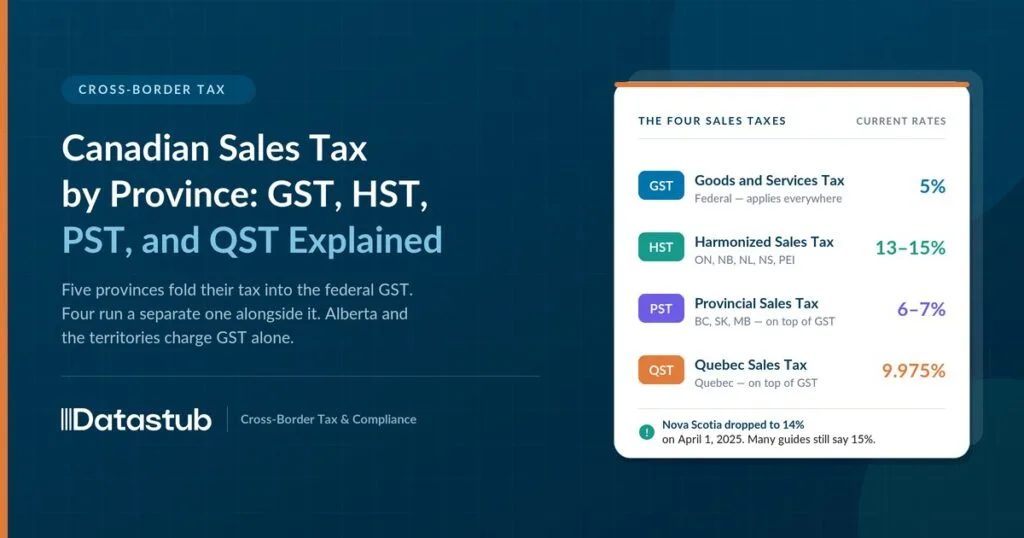
Send a $10,000 invoice to a client in Toronto and you charge 13% HST. Send the same invoice to Vancouver and it becomes 5% GST plus 7% PST, filed with two separate governments. Calgary drops to 5%. Montreal goes back to two taxes, and both go to Revenu Québec rather than the CRA.
Same company, same product, same price, but four different outcomes. That is the system working as designed rather than breaking. So once your accounting file knows which group each province belongs to, the rest runs on its own.
One Country, Three Provincial Systems
Getting this right in the books is mostly a configuration exercise, and reliable outsourced bookkeeping for a business selling across Canada starts by sorting provinces into three groups. There is a single federal tax everywhere, and then each province chose its own approach.
→ Merge the provincial tax into the federal one and charge a single combined rate. That is HST.
→ Keep the provincial tax entirely separate from GST. That is PST, or RST in Manitoba.
→ Run a parallel provincial value-added tax alongside GST. Only Quebec does this, and it is called QST.
Then a fourth group simply has no provincial sales tax at all. Alberta, the Northwest Territories, Nunavut, and Yukon charge the federal 5% and nothing more.
GST: the 5% That Applies Everywhere
Any accounting software setup for a Canadian-facing business starts with GST, because it applies in every province and territory. The rate has held at 5% since 2008, and the CRA administers it.
Because GST is a value-added tax, it does not compound as goods move down a supply chain. You collect it from customers, then recover whatever GST you paid on your own business purchases. That recovery is called an Input Tax Credit, so only the difference goes to the CRA.
For example, an Alberta contractor buying $2,000 of materials pays $100 in GST at the till. That $100 then comes back as a credit, so the net cost of GST to the business is nothing.
HST: Five Provinces, One Combined Rate
For businesses running retail bookkeeping across several provinces, the HST group is the easy one. Five provinces folded their provincial tax into GST, and the CRA administers the whole thing, so you need one registration, one return, one payment, and one tax line on the invoice.
| Province | Combined HST rate |
|---|---|
| Ontario | 13% |
| Nova Scotia | 14%, reduced from 15% on April 1, 2025 |
| New Brunswick | 15% |
| Newfoundland and Labrador | 15% |
| Prince Edward Island | 15% |
Nova Scotia’s reduction is the one to watch in the books. Because invoices, deposits, and contracts that straddle April 1, 2025 fall under transitional rules, they need reviewing individually rather than in bulk.
PST and RST: Three Provinces That Kept It Separate
British Columbia, Saskatchewan, and Manitoba each run their own tax with their own authority, registration, and taxability rules. This is the group that changes your margins, so it belongs in accounting outsourcing conversations rather than being treated as a filing detail.
The reason is simple. Because PST and RST are not value-added taxes, a business cannot recover them. So PST paid on a business purchase is a permanent cost that has to sit in your pricing and margin calculations.
For example, a Saskatchewan business buying a $5,000 diagnostic tool pays 5% GST and 6% PST. The $250 of GST comes back as a credit. But the $300 of PST never does, and it is as real a cost as the tool itself.
WORTH KNOWING
The resale exemption is the one way out of PST
Goods bought specifically for resale are the exception. In all three provinces, a business that gives its supplier a valid exemption certificate or PST number buys that inventory tax-free.
A Manitoba furniture retailer buying $40,000 of stock for its showroom pays no RST on the purchase when the certificate is on file. RST applies once instead, when a customer buys a sofa.
Each province runs its own process through the BC Ministry of Finance, Saskatchewan Finance, or Manitoba Finance. Without the certificate the supplier must charge the tax, and recovering it afterwards is difficult.
QST: Quebec’s Parallel System
Quebec runs its own value-added tax at 9.975%, and configuring it correctly is where a lot of ecommerce bookkeeping setups go wrong. Revenu Québec administers both QST and the federal GST for businesses registered there.
Like GST, QST is recoverable. The recovery just has a different name: an Input Tax Refund rather than an Input Tax Credit. Although the calculation is identical, using the right term still matters when you file.
Two rules your invoice template has to respect
✓ QST is calculated on the price before GST, not on the GST-inclusive total. On a $10,000 sale that is $997.50, never 9.975% of $10,500. This has been the rule since 2013
✓ Quebec is not harmonized, so GST and QST must appear as two separate lines. Combining them can be treated as a filing error and may block your customer from claiming their own ITR
✓ Show your CRA registration number against the GST line and your Revenu Québec number against the QST line
Which Rate Applies: the Place-of-Supply Rule
This is the rule that decides everything else, and it is worth building into your QuickBooks setup rather than applying by hand. The rate follows where your customer receives the good or service, never where your business sits.
| Province | GST | Provincial tax | Combined |
|---|---|---|---|
| British Columbia | 5% | 7% PST | 12% |
| Saskatchewan | 5% | 6% PST | 11% |
| Manitoba | 5% | 7% RST | 12% |
| Quebec | 5% | 9.975% QST | 14.975% |
| Alberta, NWT, Nunavut, Yukon | 5% | None | 5% |
Three factors decide the answer:
→ What you are supplying, since goods, services, and digital products follow different sub-rules
→ Where the supply lands, meaning the delivery address for goods and the customer’s address for services
→ Who is buying, because certain government bodies are exempt regardless of location
How it plays out
For physical goods, the delivery address governs. So an Ontario retailer shipping a laptop to Winnipeg charges 5% GST plus 7% RST. But had the same customer collected it in the Ontario store, the place of supply becomes Ontario and 13% HST applies instead. Same laptop, same buyer, yet a different pickup point means a different rate.
For services, the rate follows the customer’s address or the place the work is physically performed. So bookkeeping delivered to a client in Fredericton carries New Brunswick’s 15% HST. Meanwhile a site inspection carried out in Regina falls under Saskatchewan rules, even when the inspector’s office sits elsewhere.
For software and digital subscriptions, the customer’s location governs. And because BC, Saskatchewan, and Manitoba all now tax cloud software, a SaaS sale into those provinces carries provincial tax on top of GST.
Getting It Back: Input Tax Credits and Refunds
Sales tax should be cash-flow neutral for a registered business, and a clean month-end close is what makes that true in practice. You collect tax on sales, recover tax on purchases, and remit only the difference.
| Tax | Recoverable? | Mechanism | Filed with |
|---|---|---|---|
| GST, all provinces | Yes, in full | Input Tax Credit | CRA |
| HST (ON, NS, NB, NL, PE) | Yes, in full | Input Tax Credit | CRA |
| QST (Quebec) | Yes, in full | Input Tax Refund | Revenu Québec |
| PST / RST (BC, SK, MB) | No, a hard cost | None | Not applicable |
Most GST and HST on genuine business purchases qualifies: equipment, software subscriptions, professional fees, rent and utilities, vehicle costs, marketing. Meals and entertainment are capped at 50%, so a $200 client dinner carrying $26 of HST yields $13 of credit. Personal spending run through the business account never qualifies, whatever the receipt says.
Taxable, Zero-Rated, and Exempt
This distinction decides recovery, not just the rate, and it is the one most likely to surprise a business owner reviewing their financial reporting for the first time. Every sale falls into one of three categories.
| Category | Tax charged | Recover input tax? | Typical examples |
|---|---|---|---|
| Taxable | 5% to 15% | Yes, in full | Most goods and services |
| Zero-rated | 0% | Yes, in full | Exports, basic groceries, prescription drugs |
| Exempt | None | No | Residential rent, most financial services, health care |
Zero-rated and exempt look identical on the invoice, since neither shows tax. Still, they behave completely differently in the books.
A Nova Scotia seafood processor shipping its catch to US buyers charges no GST, because exports are zero-rated. Even so, it recovers every dollar of GST paid on packaging, refrigeration, and fuel. A financial advisor charges no GST either. But because that service is exempt, the GST paid on rent and software stays with the business as permanent overhead.
PST exemptions follow different rules entirely
Exempt from GST does not mean exempt from PST. British Columbia exempts most services but taxes goods and software. Saskatchewan, meanwhile, taxes most services, cloud software included. Manitoba then maintains its own separate list. So check each province on its own terms rather than assuming the federal treatment carries across.
When You Have to Register
Registration is triggered by worldwide taxable supplies passing $30,000, and tracking that threshold is a standard part of small business bookkeeping for anyone approaching it. The threshold is measured two ways.
→ In a single calendar quarter. Cross $30,000 in one quarter and you cease to be a small supplier on the day of that sale, which itself must include tax. You then have 29 days to register
→ Across four consecutive calendar quarters. Cross gradually and you must register by the first day of the second month after the quarter in which you went over
One CRA registration covers every HST province, so there is no separate signup for New Brunswick or Newfoundland. But it never covers the PST provinces or Quebec, since each of those needs its own.
Registering voluntarily below the threshold is often worth doing. It lets you recover ITCs on startup purchases immediately rather than absorbing them. And where your customers are registered businesses, they recover whatever you charge, so it costs them nothing. The trade-off is that you must then charge tax on all taxable sales and stay registered for at least a year.
Since November 3, 2025, registration runs exclusively through the CRA’s Business Registration Online service, because phone registration has been withdrawn. You then receive a nine-digit Business Number and a GST/HST account. The CRA does not mail confirmation, so save it at the time.
SEPARATE REGISTRATIONS
Four that a CRA number does not cover
British Columbia PST, through the BC Ministry of Finance.
Saskatchewan PST, through Saskatchewan Finance.
Manitoba RST, through Manitoba Finance.
Quebec QST, through Revenu Québec, with its own $30,000 threshold measured on Quebec sales.
Filing Frequency and the Quick Method
The CRA assigns your filing frequency by revenue and adjusts it as you grow, which makes a filing calendar worth building once rather than reconstructing each quarter.
| Frequency | Annual taxable revenue | Return due |
|---|---|---|
| Annual | Under $1.5 million | Three months after fiscal year-end, with quarterly instalments if net tax is $3,000 or more |
| Quarterly | $1.5 million to $6 million | One month after each quarter ends |
| Monthly | Over $6 million | One month after each month ends |
Filing is required even in a period with no sales. After all, a nil return is still a return, and skipping it triggers late-filing penalties.
The Quick Method
Smaller registrants can elect a simplified remittance option that skips ITC tracking entirely. So instead of reconciling credits on every purchase, you remit a fixed reduced percentage of your tax-included sales and keep the difference. You also get a 1% credit on the first $30,000 of eligible supplies each year.
The eligibility test is narrower than it first appears:
✓ Worldwide taxable supplies, including GST/HST and zero-rated sales and those of associated businesses, at $400,000 or less
✓ A permanent establishment in Canada, which rules the method out for non-resident sellers
✓ In business at least 365 days, or a new registrant reasonably expecting to stay under the ceiling
✓ Not on the excluded list, which covers accountants, bookkeepers, lawyers, financial consultants, and listed financial institutions. We are on that list ourselves
✓ Elected actively through Form GST74 or My Business Account, since it never applies automatically, and kept for at least one year
It suits a low-cost service business. For example, a designer billing $90,000 a year with a laptop and a few subscriptions usually keeps more under the Quick Method than she would recover through ITCs. But a business with real input costs, whether inventory, equipment, or contractor spend, generally does better on the regular method. So run both before electing.
Getting Invoices Right
Your customer’s ability to claim their own ITC or ITR depends on what your invoice shows, and the requirements scale with the value of the sale.
| Invoice total | What it must show |
|---|---|
| Under $30 | Your business name, the date, and the total paid |
| $30 to $149.99 | The above, plus your GST/HST registration number and whether tax is included or shown separately |
| $150 and over | The above, plus the customer’s name, a description of what was supplied, and payment terms |
The registration number is the one that causes friction. Because if you leave it off an invoice above $30, your business customer cannot claim their credit, which then turns into a support conversation you did not need.
Final Thought
Canadian sales tax looks complicated because there are genuinely several systems running at once. In practice it reduces to one question your accounting system should answer automatically: where is the customer?
Answer that reliably and everything downstream follows. The right rate applies, the right registrations get opened, the invoice carries the right lines, and the filing calendar covers every authority you owe. Meanwhile, most sales tax trouble traces back to businesses that never nailed down customer location in the first place.
Selling into Canada, or expanding into new provinces? Reach out to Datastub for a free review of your setup and we will tell you straight what is working and what needs fixing.