

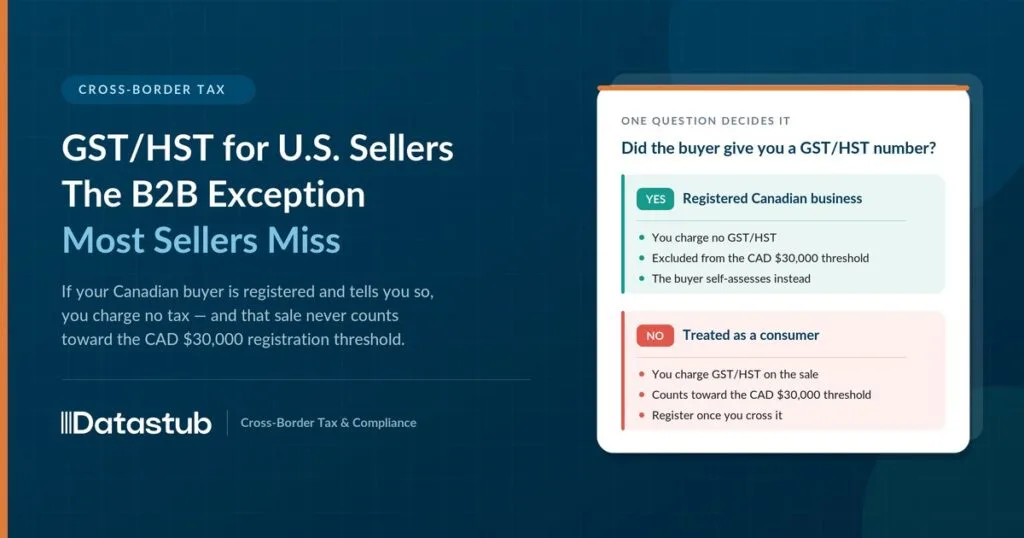
A U.S. software company starts picking up Canadian customers. Somebody asks whether GST applies. The answer circulating online is that since 2021, non-resident sellers must register once Canadian sales pass CAD $30,000.
That is true for some sellers, but wrong for many others. The rule turns on who your customers are. So for a business selling to other businesses, the obligation often does not arise at all.
What Changed in 2021
Before July 2021, a non-resident with no Canadian presence generally collected nothing, and ecommerce bookkeeping for cross-border sellers reflected that. U.S. streaming services and SaaS companies simply did not charge GST.
Canada then introduced a simplified registration regime for the digital economy. Since July 2021, non-resident vendors and platform operators can be required to collect and remit GST/HST once they pass CAD $30,000 over a twelve-month period. No office, employees, or physical presence is needed.
So far this matches what most summaries say. But the part they leave out is who the rule actually reaches.
The B2B Exception Most Sellers Miss
This is the single most valuable thing to establish before you register anything, and it belongs in the sales tax review rather than being discovered afterwards. The simplified regime applies to business-to-consumer sales only.
The obligation is triggered by supplies to a “specified Canadian recipient.” That means a Canadian consumer. It also means a Canadian business that is not registered under the normal GST/HST regime, or that has not given you its registration number.
Turn that around and the practical rule is simple. When your Canadian customer is a registered business and gives you its number, that sale falls outside the simplified regime. The customer self-assesses instead. So you collect nothing.
THE PRACTICAL TEST
Who is buying decides whether you register
Selling mainly to Canadian consumers, or to small businesses below the $30,000 threshold that are not registered? Those are specified Canadian recipients, and the simplified regime applies once you pass CAD $30,000.
Selling mainly to registered Canadian businesses that supply their GST/HST numbers? Those supplies sit outside the regime, and a purely B2B seller may have no federal registration obligation at all.
Mixed book? Only the B2C portion counts toward the threshold. Collect and store customer registration numbers, because that record is what supports the position later.
Either way, provincial obligations are decided separately. Federal relief is not provincial relief.
Simplified or Normal Registration
If you do need to register federally, the choice between the two regimes changes your cash position. So it is worth modelling before you file anything. A virtual CFO view helps here, because the cheaper option to administer is not always the cheaper option overall.
| Simplified regime | Normal regime | |
|---|---|---|
| Applies to | B2C supplies only | All taxable supplies made in Canada |
| Input tax credits | Not available | Recoverable in full |
| Registration route | Online, no Business Number | Business Number required |
| Business Registration Online | Not applicable | Not available to non-residents without a Canadian address |
| Security deposit | Not required | Generally required where there is no permanent establishment in Canada |
| Quick Method | Not available | Not available without a permanent establishment |
| Reporting | Quarterly, CAD or USD accepted | Frequency set by revenue |
Two rows in that table catch U.S. sellers out. First, the simplified regime bars input tax credits entirely. That is the trade for a lighter compliance load. But if you carry real Canadian costs, those credits are worth money, and simplified registration gives them up.
Second, normal registration is not simply a form. A non-resident without a permanent establishment in Canada generally has to post security with the CRA and keep it in place. That seller also cannot use Business Registration Online without a Canadian address. So budget time for both.
When the Platform Owes the Tax Instead
Marketplace rules shift the obligation away from the vendor in two situations, and reconciling them correctly is a recurring Amazon and Shopify bookkeeping problem, since the platform may be remitting tax that never appears in your own filings.
→ Goods sold from Canadian fulfillment warehouses. Where a distribution platform sells goods on behalf of a non-resident vendor and the goods sit in Canada at the time of sale, the platform collects and remits rather than the vendor
→ Short-term accommodation. Platforms collect on bookings made through hosts who are not GST/HST registered, while a registered host remains responsible for its own
So reconcile platform-collected tax separately from anything you collect directly. Otherwise you risk double-counting it in a return, which is a common and avoidable error.
The Provinces Move Separately, and They Are Moving
Federal registration decides nothing about provincial tax. And this is where cross-border sales tax compliance has shifted fastest. Three provinces now tax cloud software, and their rules reach non-resident providers directly.
| Province | Position on SaaS and cloud | Effective |
|---|---|---|
| British Columbia | PSTA definition of software expanded to include SaaS, IaaS, and APIs | Retroactive to April 1, 2013 |
| Saskatchewan | PST applies to SaaS and cloud software used in the province | In force |
| Manitoba | 7% RST extended to SaaS, PaaS, and IaaS by Bill 46 | January 1, 2026 |
| Quebec | QST rules run parallel to the federal digital regime | In force |
British Columbia is the one to check historically rather than prospectively. Because the amendment was made retroactive to 2013, overturning a court decision that had excluded cloud services, exposure there can predate the announcement.
Manitoba is now enacted law rather than a budget proposal, and it reaches resident and non-resident providers alike. Still, one transitional relief is worth knowing. Services paid for before January 1, 2026 are not taxable, even where the subscription period runs past that date.
EASY TO GET WRONG
Federal relief is not provincial relief
A U.S. SaaS company selling only to registered Canadian businesses may have no simplified GST/HST registration obligation at all.
That same company can still owe Saskatchewan PST, Manitoba RST, and British Columbia PST on those identical sales, because provincial rules do not carry a B2B carve-out equivalent to the federal one.
Quebec sits in its own category again, with QST registration assessed separately against Quebec sales.
So work the federal question and the provincial questions independently. Answering one does not answer the other.
Working Out What You Actually Need
Before registering anything, run the analysis in order. Because doing this properly once is far cheaper than unwinding registrations later, it is the first thing we do in any cross-border accounting engagement of this kind.
1. Segment your Canadian customers
Split the book into registered businesses and everyone else. Then capture and store GST/HST numbers for the registered ones, because that documentation is what supports leaving those sales outside the federal regime.
2. Measure the B2C portion against CAD $30,000
Only supplies to specified Canadian recipients count toward the federal threshold over a twelve-month period. So a largely B2B seller may sit well under it, despite substantial Canadian revenue.
3. Decide simplified or normal, if either applies
Simplified is faster, but it forfeits input tax credits. Normal recovers them, although it brings a Business Number, a likely security deposit, and no access to Business Registration Online without a Canadian address.
4. Map customers by province, not by country
Provincial obligations turn on where each customer sits. So Saskatchewan, Manitoba, and British Columbia each need separate assessment for software and cloud sales, while Quebec needs its own QST analysis.
5. Configure tax codes before the next invoice run
Set the correct treatment per province and per customer type in your billing system. Then test one invoice for each combination, because retrofitting this across issued invoices is far more work than configuring it once.
6. Build one filing calendar across every registration
Federal returns, QST, and each provincial PST or RST all run on their own schedules. And nil returns still have to be filed, since missing one carries penalties even with no revenue in the period.
Final Thought
The question that decides everything here is not whether you sell into Canada. It is who buys from you and where they sit, which is why this belongs in your bookkeeping process rather than in a one-off registration decision.
Get customer segmentation and province mapping right, and the rest follows mechanically. Get them wrong and one of two things happens. Either you over-register and remit tax you never owed, or you under-register and carry exposure across provinces whose rules changed while you were not watching.
Datastub works with U.S. and Canadian businesses on exactly this: mapping customers by province, determining which registrations are genuinely required, configuring invoicing so the right rate applies automatically, and building a filing calendar that covers GST/HST, QST, and every provincial PST or RST you owe. Already selling into Canada and unsure your setup holds up? We will review it and tell you plainly what is right and what needs fixing.
Selling into Canada and unsure what you owe?
We will map your customers by province, work out which registrations you actually need, and tell you straight where the gaps are. Free consultation, no pressure.