

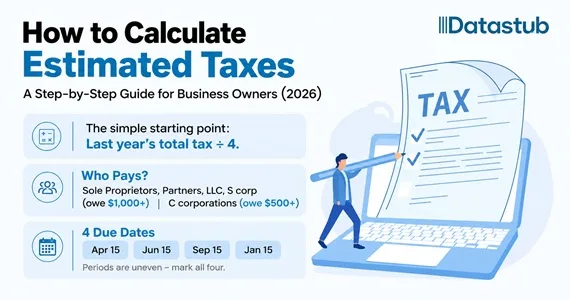
Here’s how much to send the IRS each quarter: last year’s total tax, divided by four.
For most business owners, that single number buys protection all year — no forecasting, no guesswork, no April surprise. This guide explains why that works, when a different number serves you better, and the exact math behind what you owe — so the amount on your tax bill stops being a mystery.
Why the IRS wants four payments, not one
The US tax system is pay-as-you-go. The IRS expects to receive taxes in roughly the same rhythm you earn the income — not in one lump sum the following April.
Employees never notice this because their employer handles it. A slice of every paycheck goes straight to the IRS on their behalf, guided by the W-4 form they filled out on day one. By the time they file, they’re mostly just settling the difference.
When you own the business, that job becomes yours. There is no W-4 for business profit. Customers pay you the full invoice, every deposit lands whole, and somewhere inside those deposits is money that was never really yours. You are now your own withholding department — and instead of a slice of every paycheck, you send the IRS four payments a year.
These payments are called quarterly estimated taxes. The name makes them sound complicated. They’re not — they’re a schedule and a formula, and you’re about to have both.
Who needs to make these payments
The trigger depends on how your business pays its tax:
Business income that lands on your personal return — sole proprietors, partners, LLC members, S corporation shareholders. If you expect to owe $1,000 or more for the year beyond any withholding, quarterly payments apply. This is most small business owners.
A business that pays its own tax — C corporations filing Form 1120. The trigger is lower: expect to owe $500 or more, and quarterly payments apply.
The calculation works differently for each, so this guide covers them separately below.
The four dates — and the odd calendar behind them
Here’s the schedule for individuals and pass-through owners:
| Payment | Covers income earned | Due date |
| 1st | January – March | April 15 |
| 2nd | April – May | June 15 |
| 3rd | June – August | September 15 |
| 4th | September – December | January 15 (next year) |
Notice something? “Quarterly” doesn’t mean every three months. The second payment covers only two months of income, and the third arrives after a three-month gap. The calendar is uneven, which is exactly why owners who rely on memory miss the June and September dates most often. Put all four on your calendar today — the next one up is September 15.
(C corporations use a different schedule — theirs is below.)
If your business income lands on your personal return: the calculation
This is the section for sole proprietors, partners, and S corporation owners. Your business profit flows onto your personal return, so “business tax” and “personal tax” are the same calculation — it just runs through personal tax brackets.
Here’s the full walkthrough. Say Maya runs a painting business as a sole proprietor — reporting on Schedule C — files single, and expects $100,000 of profit this year:
| Step | What’s Happening | The Math |
| 1 | Expected business profit | $100,000 |
| 2 | Self-employment tax (Social Security + Medicare): profit × 92.35% × 15.3% | $14,130 |
| 3 | Adjusted income: profit minus half the SE tax ($7,065) | $92,935 |
| 4 | Minus the standard deduction (single, 2026) | − $16,100 → $76,835 |
| 5 | Minus the 20% business income deduction most owners qualify for (QBI) | − $15,367 → $61,468 |
| 6 | Income tax on $61,468 using 2026 brackets | $8,235 |
| 7 | Total estimated tax for the year: $14,130 + $8,235 | ≈ $22,400 |
One line in that table depends on your business structure — the self-employment tax. It applies when you report business income on Schedule C, as Maya does (sole proprietors and single-member LLCs). If your business is an S corporation, skip that line for your profit share: Social Security and Medicare were already handled through payroll on your salary, so your estimate covers income tax only. Partners, it usually depends on your role — general and active partners typically do pay self-employment tax on their share, while limited partners generally don’t. This one line is worth a five-minute conversation with your accountant, because it’s the difference of five figures in math.
Two more things worth noticing.
- For Schedule C owners there are two taxes in that stack, not one. Self-employment tax — the $14,130 — is actually the bigger piece at this income level. It’s the version of Social Security and Medicare that a paycheck would have split with an employer. Owners who only think about income tax consistently underestimate what they owe, and this is why.
- Look at the effective rate: $22,400 on $100,000 of profit is about 22%. Hold that thought — it explains the set-aside rule of thumb later in this guide.
How much to actually pay: the three paths
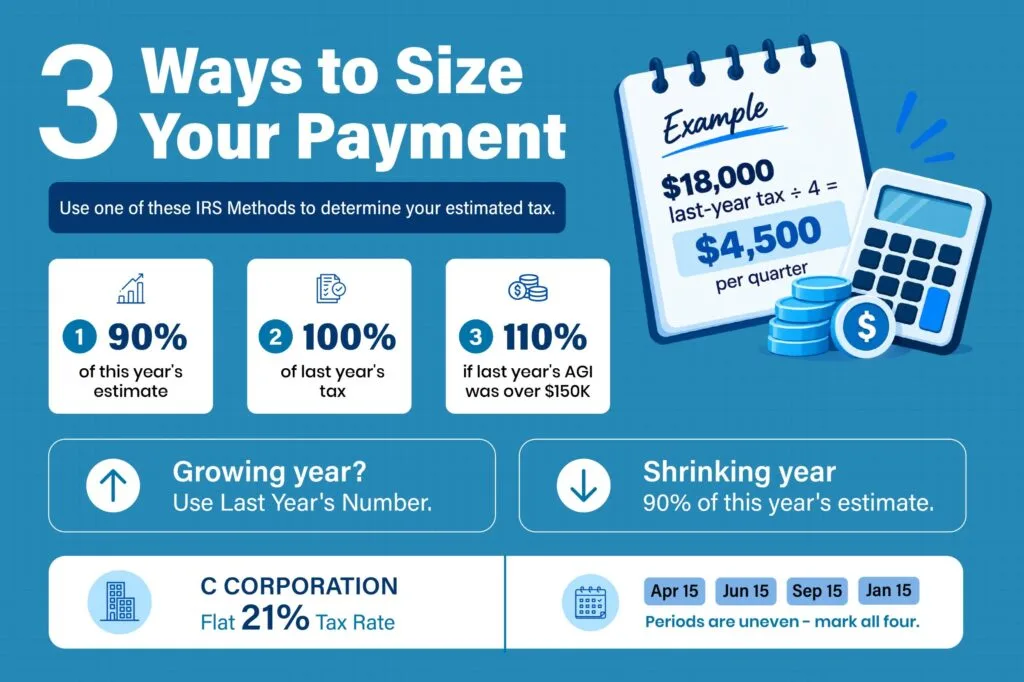
The IRS gives you more than one acceptable way to size your payments, and you’re allowed to pay the smallest one available to you:
| Path | The Rule | Maya’s Math | Per Quarter |
| This year’s estimate | 90% of the current year’s tax | $22,400 × 90% = $20,160 | $5,040 |
| Last year’s number | 100% of the prior year’s total tax | $18,000 | $4,500 |
| Last year’s number, high earners | 110% of the prior year’s tax — required in place of the 100% path if last year’s AGI was over $150,000 | $18,000 × 110% = $19,800 | $4,950 |
Maya’s tax last year was $18,000 and her AGI was under $150,000 — so the middle path wins: $4,500 per quarter, and no nine-step calculation required after the first one.
That prior-year path has a name, and it’s the most valuable rule in this entire guide.
Why it’s called the safe harbor
Pay based on last year’s number — 100%, or 110% for high income earners — and you’re protected no matter how big this year turns out to be.
That’s the whole promise, and it holds even when the year outruns every plan. Suppose Maya’s business surges and her actual tax lands at $32,000 instead of the $22,400 she estimated. Nothing changes: she keeps paying $4,500 each quarter and settles the remaining $14,000 when she files in April — with zero interest charges, because she followed the rule all year. Her biggest year ever, and not a single surprise notice.
The safe harbor turns estimated taxes from a forecasting problem into a calendar reminder: one number from a return you already filed, divided by four.
When to pay based on this year instead
So when does the 90% path win? When the current year profit is smaller than last year. If last year was a banner year and this year has cooled off, anchoring to last year’s tax means overpaying — handing the IRS an interest-free loan until your refund arrives. In a shrinking year, run the calculation above on this year’s expected profit and pay 90% of that instead.
The practical shortcut: growing or steady year, anchored to last year’s number. Shrinking year, switch to 90% of the current-year estimate.
Skipping a payment is a 7% loan from the IRS
Here’s the honest framing of the “penalty,” because the word oversells it.
When you skip or underpay a quarterly installment, the IRS doesn’t fine you a flat amount. It charges interest on the shortfall — currently 7% per year for the quarter that began July 1, 2026, compounded daily. The rate resets every quarter (it was 6% in the spring), but it tracks a few points above short-term rates.
In other words: skipping estimated payments is quietly taking out a loan from the IRS at 7% — a loan you never applied for and can’t negotiate.
To size it: miss a $4,500 September 15 payment entirely and settle it when you file the following April, and the interest runs about $185. Not a catastrophe — but it bought you nothing. It’s pure cost, and avoiding it takes a five-minute online payment.
The flip side is genuinely encouraging: interest stops accruing on any amount the moment you pay it. If you’re behind right now, catching up today is worth more than catching up in January. There’s no reason to wait for a “clean” quarter to start.
Seasonal income? There’s a method for that
Seasonal businesses know the pattern: most of the year’s money arrives in a few busy months, but the payment schedule starts in April — sometimes before the season has produced a dollar.
The tax code accounts for this. There’s a method that matches your payments to when your income actually arrives, so a slow first quarter means a smaller first payment, and the bigger payments follow the busy months. It’s called the annualized income installment method, and your tax preparer claims it by filing Form 2210 with Schedule AI along with your return — that schedule is what shows the IRS your income arrived unevenly, so uneven payments were the right ones. You don’t need to master the form; you just need to ask for the method by name so an uneven year doesn’t force even payments.
If your business pays its own tax: C corporations
If your business files as a C corporation on Form 1120, the calculation is simpler — but the rules around it are tighter.
The calculation. C corporations pay a flat 21% on taxable income. A corporation expecting $200,000 of taxable income this year owes 21% × $200,000 = $42,000, paid as four installments of $10,500.
The dates are different. A calendar-year C corporation pays on April 15, June 15, September 15, and December 15 — the fourth payment lands inside the year, not the following January.
There’s no 90% cushion and no 110% tier. The baseline expectation is 100% of the current year’s tax, paid in four installments. The corporation is expected to track its income as the year unfolds and size payments accordingly.
The prior-year anchor comes with conditions. A smaller C corporation can still base payments on 100% of last year’s tax — if last year was a full 12-month tax year and the return showed an actual tax liability. In our example, if the corporation’s prior-year return showed $30,000 of tax, it could pay four installments of $7,500 and settle the difference at filing. But a loss year or a short first year takes that option off the table entirely. And once a corporation has had $1 million or more of taxable income in any of the three prior years, it’s classified as a large corporation: last year’s number can be used only for the very first installment, and everything after must be based on current-year income.
The practical takeaway: pass-through owners get a set-and-forget number. C corporations need a running estimate of the current year’s income — which means current books, not books that get caught up in March. If your corporation’s financials run weeks behind, that’s the first thing to fix, and our Complete Guide to Bookkeeping Services covers what current, usable books look like.
The set-aside habit that makes all of this automatic
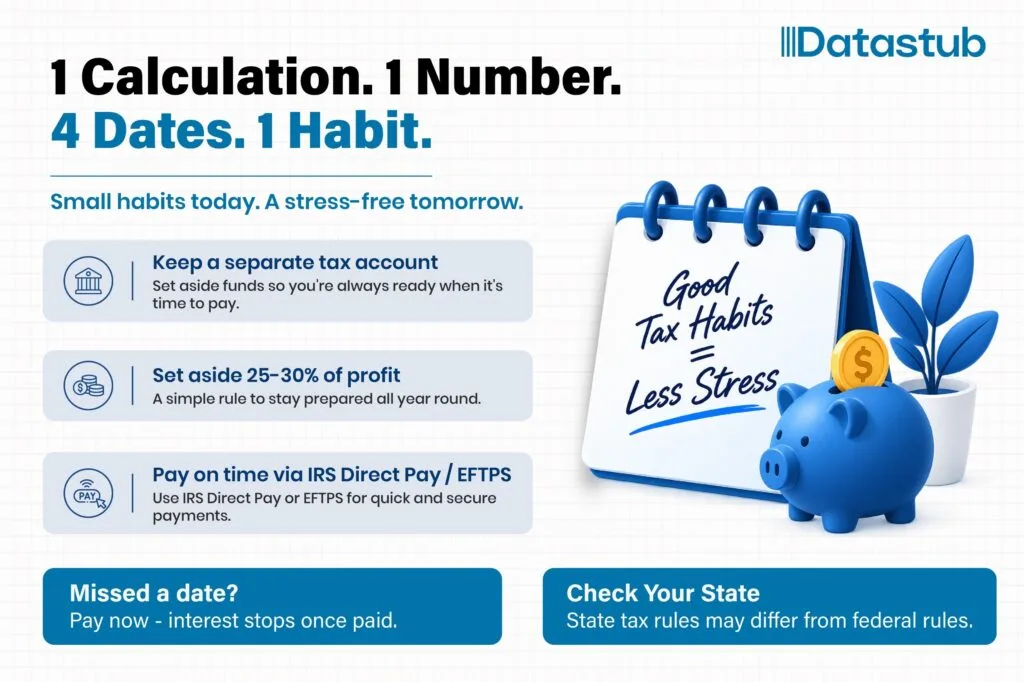
Knowing the rule is half the job. The other half is having the money ready when the date arrives — and that’s a cash flow habit, not a tax skill.
The system the best operators use has three parts:
A separate account. Open a savings account that exists only for taxes. Money in your operating account always looks spendable; money in a tax account doesn’t.
A fixed percentage of every deposit. Move 25–30% of profit into the tax account as the money arrives — monthly at minimum, weekly if your deposits are frequent. Remember Maya’s effective rate from the calculation: about 22% federal. The 25–30% habit covers that with room for state tax on top. Your accountant can tighten the percentage to your actual situation, but the habit matters more than the precision.
A five-minute payment. When the quarterly date comes, pay online through IRS Direct Pay or EFTPS. No paper vouchers, no checks in the mail, no wondering if it arrived. The money is already sitting in the tax account, so the payment is a transfer, not a scramble.
This habit is really a cash flow discipline wearing a tax costume — the same “know what’s actually yours” principle we walk through in our Cash Flow Management: The Definitive Guide.
Your before-September-15 checklist
- Pull last year’s return and find your total tax — that’s the anchor number.
- Divide by four (use 110% first if your AGI was over $150,000).
- Run the full calculation once with your accountant so you know your real effective rate — and confirm whether the self-employment tax line applies to your structure.
- Add all four due dates to your calendar with a one-week-early reminder.
- Open the separate tax savings account and set the transfer percentage.
- Behind on a payment this year? Pay what you can now — interest stops on every dollar the day it’s paid.
- Check whether your state has its own estimated payments (most do, with their own dates).
- C corporation? Confirm whether the prior-year option is available to you, and make sure your books are current enough to estimate this year’s income.
How Datastub Helps
Estimated taxes sit at the intersection of two things we do every day: keeping your books current enough that “how much am I earning” has a real answer, and turning that answer into a payment plan you never have to think about.
Our bookkeeping and outsourced accounting teams keep the numbers live. On the planning side, we run the full calculation for your actual structure, calculate your safe harbor, recalibrate mid-year if your income shifts, handle the seasonal method when payments should follow your busy months, and coordinate the state-level payments alongside the federal ones. For S corporation owners, we align your payroll withholding with your estimates so the two systems work together instead of leaving gaps. And when the question grows from “how much do I send” to “how should I plan the whole year,” that’s the conversation our Virtual CFO service was built for.
FAQ
I’m an S corporation owner and I already run payroll for myself. Do I still need estimated payments?
Maybe not — the withholding on your salary counts toward your annual requirement. But your share of the company’s profit flows to your personal return without withholding, so if the profit is meaningful, you’ll either make estimated payments on that portion or increase your payroll withholding to cover it.
I also have a W-2 job (or my spouse does). Can that paycheck cover my business taxes?
Yes — and it’s one of the most useful levers in the system. You can raise the withholding on the W-2 paycheck (a new W-4 with an extra withholding amount) so it covers the business tax too, and skip quarterly payments entirely. Withholding has a quiet advantage: the IRS treats it as paid evenly across the year no matter when it actually came out. Realize in October that you’re behind? A withholding boost in the final paychecks of the year can retroactively fix all four quarters — something an estimated payment can’t do.
I missed the April and June payments this year. What now?
Start now. Interest only accrues on unpaid amounts, and it stops on every dollar the day you pay it. Send the September payment on time, add what you can toward the earlier shortfall, and you’ve already cut the cost. Missing two payments doesn’t spoil the year — it just makes today the best day to begin.
Do states have their own estimated taxes?
Most states with an income tax do, with their own thresholds and due dates — often matching the federal calendar, but not always. If you pay federal estimates, assume your state expects payments too until you’ve confirmed otherwise.
My income is seasonal. Do I really have to pay in April when the season hasn’t started?
No — the annualized income installment method sizes each payment to the income you’ve actually earned by that point in the year. Your tax preparer files Form 2210 (Schedule AI) with your return to claim it. If your revenue is concentrated in a few months, ask about it by name.
How do I actually send a payment?
IRS Direct Pay (straight from a bank account, no login required) or EFTPS (a free enrollment-based system many businesses prefer). Both take minutes and give you a confirmation. C corporations pay through EFTPS. No paper forms are needed to make an online payment.
What if I overpay?
You’ll get it back as a refund when you file — or you can roll it forward and let it count as your first payment for the next year, which many owners prefer because it gives the new year a head start.
Final Thought
Estimated taxes have a reputation as one of the stressful parts of owning a business. It shouldn’t. The system runs on one calculation you do once, one number you already have, four dates you can put on a calendar in the next two minutes, and a savings habit that takes care of everything in between. Owners who set this up once describe the same thing: tax season stops being an event. It becomes a formality.
If you’d like a second set of eyes on your numbers, reach out to Datastub for a free 15-minute review — we’ll run your calculation, check where you stand for September 15, and tell you straight whether anything needs to change.
This article is for general information only and is not tax advice. Rules, rates, and thresholds change, and your situation is unique — consult a qualified professional about your specific circumstances.